
Tesagan Gin Je Chinatown Traditions: Beyond the Food, Into the Ritual Locals Protect

What Most People Miss About Tesagan Gin Je in Chinatown
The yellow flags are the signal. When they appear along Yaowarat Road and thread down into the narrow lanes of Charoen Krung Road Soi 20 in late September, Bangkok's Chinese Taoist community has already begun a period of spiritual preparation that most outsiders never witness. The Vegetarian Festival — Tesagan Gin Je — runs October 10–18, 2026, but the ritual infrastructure is being built days before the first official morning.
This is not a food festival that happens to have religious undertones. It is a profound merit-making and spiritual purification ceremony rooted in Chinese Taoist tradition, in which the act of abstaining from meat, alcohol, and sensory excess is a vehicle — not the destination. Locals protecting these traditions understand that distinction viscerally, and it shapes every aspect of how the festival unfolds in Bangkok's Chinatown.
Yaowarat is not a backdrop. It is the living carrier of this ritual. The same families who operate century-old shophouses on Charoen Krung Road are the custodians of the temple rites, the jay food kitchens, and the strict behavioral codes that govern the ten days. For a newcomer arriving here in October, the experience of understanding why the rituals exist — not just what they look like — transforms a tourist walk into a genuine encounter with one of Bangkok's most privately guarded cultural inheritances.
The Ritual Architecture of Tesagan Gin Je in Yaowarat
What is the Vegetarian Festival (Tesagan Gin Je) in Bangkok's Chinatown?
The Vegetarian Festival (Tesagan Gin Je) is a ten-day Taoist spiritual cleansing ritual observed across Bangkok's Chinatown (Yaowarat) from October 10–18, 2026. Participants abstain from meat, alcohol, and sensory excess as an act of merit-making, purification, and devotion at Chinese temples throughout the district.
The Nine-Day Purity Code
At the heart of Tesagan Gin Je is a codified set of ten abstentions that practitioners follow for the full festival duration: no meat, no dairy, no alcohol, no sex, no lying, no killing, and several more that regulate spiritual cleanliness at a granular level. This is not a dietary guideline — it is a moral framework, and locals who observe it fully describe the cumulative effect of nine days inside it as transformative in ways a single evening of vegan street food cannot replicate.
The Chinese temples clustered around Yaowarat and Charoen Krung Road Soi 20 function as the festival's operational heart. Each temple coordinates its own schedule of prayers, offerings, and processions. The altar preparations — the arrangement of fruit, incense, and ceremonial candles — follow protocols that temple elders have maintained across generations, and which are not explained on signboards for the casual visitor.
The Processions Locals Never Miss
The street processions that move through Chinatown during Tesagan Gin Je are among the most visually intense public events in Bangkok. Participants enter trance-like states, some performing acts of ritualized self-mortification understood within the tradition as demonstrations of devotion and proof of spiritual protection. Locals position themselves at specific junctions on Yaowarat Road not for spectacle but because they understand the procession route's significance — which temples are leading, which deities are being honored, and at what hour the energy of the ceremony peaks.
"The Vegetarian Festival is one of those Bangkok events where the entire meaning lives below the surface. If you only see the yellow flags and the jay food, you've arrived at the lobby of a building you haven't entered yet." — Bangkok-based cultural researcher with fifteen years observing the Chinatown district
The Jay Food Economy — and Why It Matters Beyond the Plate
The explosion of jay (vegan) food stalls along Charoen Krung Road during the festival is well-documented. Less understood is the religious logistics behind it. Vendors who serve jay food during Tesagan Gin Je are themselves bound by the purity codes for the festival's duration. The kitchen is a ritual space. Ingredients are sourced, prepared, and served under conditions that mirror the temple altar protocols — a continuity of spiritual cleanliness from field to plate that gives the food its sacred character within the tradition.
For residents of the Charoenkrung and Talat Noi area, the festival is not a disruption but an annual restoration of the neighborhood's core identity. The same creative district that has seen gentrification — heritage shophouses converted into art spaces, Song Wat Road lined with design studios, MRT Sam Yot Station bringing a new wave of visitors — pauses its contemporary layer and reasserts the Chinese-Taoist foundation that was always underneath it.
Living in the Chinatown District During the Festival: Practical Realities
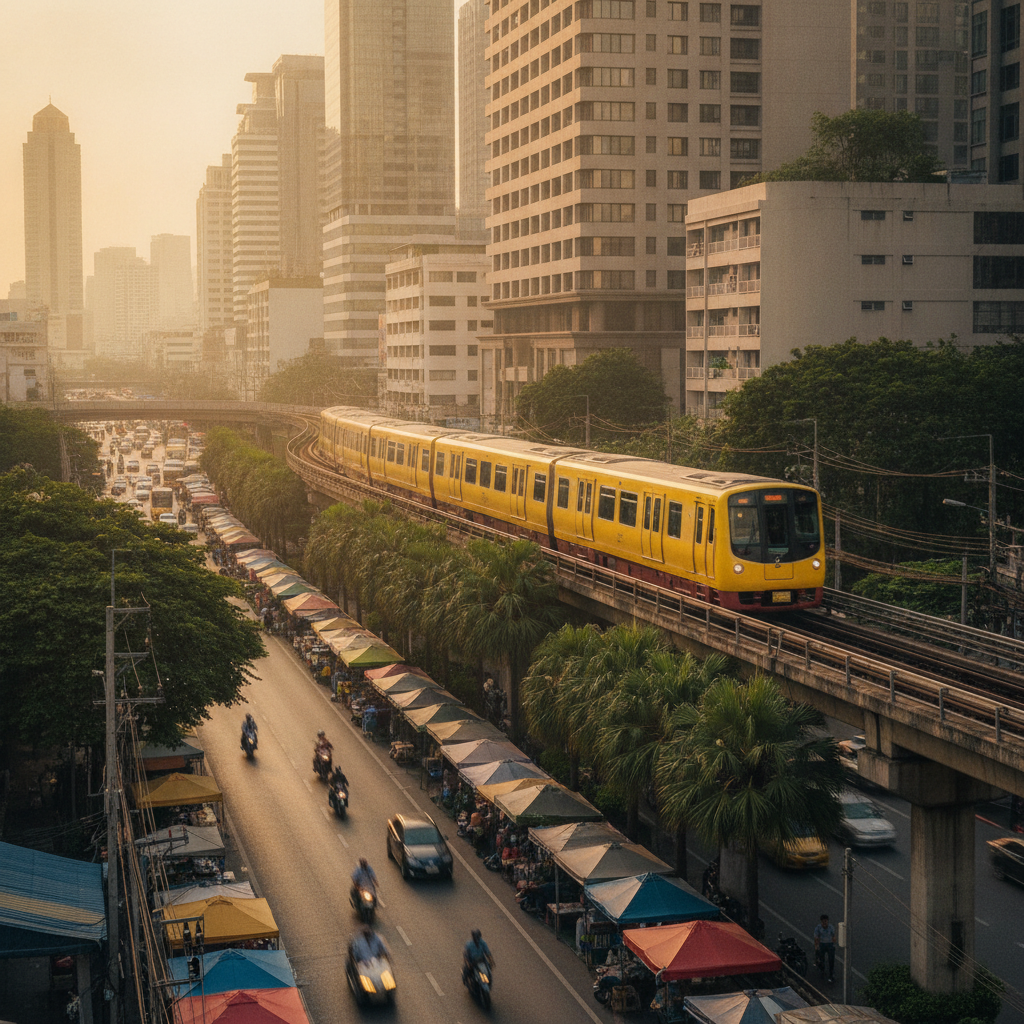
- Transit access: The MRT Blue Line's Sam Yot Station places you directly at the edge of the Chinatown district. From June 2026, the MRT Blue Line went fully contactless with EMV tap-to-pay, making festival navigation significantly easier — no stored-value card required, tap in and out seamlessly even during the crowded October peak.
- Dining calibre in the wider corridor: Beyond jay food during the festival, the surrounding Sathorn and Chinatown corridor supports year-round fine dining of serious calibre. POTONG — a multi-floor fine dining experience inside a restored Chinatown shophouse on Yaowarat — is considered one of Bangkok's most architecturally and culinarily unique restaurants, and is the permanent expression of exactly the creative-heritage fusion the district now embodies. Maison Dunand in Sathorn brings French-alpine technique to local Thai ingredients for occasions that demand formality.
- October cultural calendar: Tesagan Gin Je (October 10–18) lands inside a dense cultural window. The World Gourmet Festival runs September 29 – October 4, 2026 at the Anantara Siam Bangkok Hotel on Rajadamri Road — international chefs and Michelin-calibre menus in the week immediately before the festival. The MOLLY 20th Anniversary Exhibition at Chulalongkorn University Centenary Park runs through October 25, offering contemporary pop-art contrast in the weeks bracketing the ritual season.
- Green space proximity: Lumphini Park — a 15-minute ride on the MRT from the Chinatown district — offers the clearest decompression from Yaowarat's festival-period intensity. Its 2.5 km jogging track and free evening aerobics at 5:30 PM are fixtures for residents who use the park daily. The renovated Green Bridge (Saphan Khiao) extends the green corridor directly to Benchakitti Forest Park, a secondary retreat favored by residents who know the route.
- Art concurrent with ritual: The 'Transverse: Navigating Emerging Thai Art' exhibition at the Four Seasons Hotel Bangkok ART Space by MOCA Bangkok runs until September 27, 2026 — a final week of gallery-quality Thai art viewing before the festival season fully absorbs the cultural conversation. River City Bangkok, adjacent to the Charoenkrung creative district, maintains its gallery programming throughout October as well.
For expat families considering the Charoenkrung corridor, the district's international school proximity is worth noting. St Andrews International School Bangkok's Sathorn campus is within reasonable transit distance, and the central location provides access to the BTS/MRT network that connects to NIST International School in Wattana District (Sukhumvit Soi 15) and Bangkok Patana School in Bang Na. For a deeper breakdown of school-district alignment, our guide on Bangkok's best family-friendly neighborhoods for expats: schools, amenities, and transit in 2026 maps the full picture.
Charoenkrung and Talat Noi: The Investment Case Behind the Cultural Layer
The Tesagan Gin Je ritual is inseparable from the property story of Bangkok's Chinatown district. Yaowarat and the broader Charoenkrung-Talat Noi corridor are in active gentrification — heritage shophouses converting into art spaces, cafés, and creative studios along Song Wat Road, anchored by MRT Sam Yot accessibility. The cultural identity that makes the Vegetarian Festival possible is the same cultural gravity that is driving sophisticated buyer interest in this district.
Bangkok's luxury property market in 2026 remains bifurcated. While mass-market condominiums under THB 3 million face a genuine slowdown — with developers offering discounts and prioritizing cash buyers — premium and well-located assets with authentic cultural character and strong foreign buyer appeal are holding firm. The Charoenkrung waterfront corridor fits squarely into the resilient segment, for the same reason POTONG restaurant chose a Chinatown shophouse rather than a Sukhumvit tower: the authenticity premium is real and quantifiable.
For comparison, the Wireless Road and Langsuan corridor — Bangkok's benchmark luxury district — delivers capital appreciation of 6–8% per year historically, with prices ranging from THB 250,000–450,000 per square metre. The Charoenkrung waterfront, while at an earlier stage of its premium curve, carries the same ingredient set: UNESCO-adjacent heritage character, infrastructure investment (MRT Blue Line contactless upgrade, Chao Phraya waterfront redevelopment), and an incoming resident profile that values authenticity over amenity density.
Foreign buyers using remitted equity — rather than local mortgages — are the dominant acquisition force in Bangkok's premium segment in Q1 2026, and the 49% foreign freehold quota in condominium buildings remains the cleanest legal pathway for international ownership. Nominee structures for landed property are under intensified regulatory scrutiny in 2026, making condo freehold the unambiguous preferred vehicle for foreign buyers in districts like this.
For a rigorous analysis of yield differentials across Bangkok districts right now, our report on smart investing in Bangkok 2026: rental yields and capital growth in a segmented market provides the granular breakdown. And if you are calibrating timing around government incentives, the analysis of the extended 0.01% property transfer fee window until June 2027 is essential reading before you close.
The Chao Phraya waterfront transformation adds another dimension to the investment thesis. For the full picture on how Bangkok's riverfront redevelopment is reshaping residential values in this corridor, our deep-dive on Chao Phraya waterfront condo green space and Bangkok's riverfront transformation is the most detailed account currently available.
Request a Private Property Consultation for the Charoenkrung District
If the Chinatown and Charoenkrung corridor — its cultural depth, its waterfront positioning, and its early-stage premium trajectory — is on your shortlist, the conversation is worth having before October's festival season closes and Q4 buyer activity accelerates.
Our team specializes in the Bangkok premium and ultra-luxury residential segment, with direct access to developer inventory, resale assets, and off-market listings in the Charoenkrung-Talat Noi area that do not appear on aggregator portals.
Reach out to arrange a private consultation, floor-plan analysis, or a curated viewing itinerary. There is no obligation and no hard sales process — only a precise, honest assessment of what is available in this district at this moment in the market cycle.
Contact The Realtors Bangkok to schedule your private Charoenkrung district consultation. We respond within one business day.