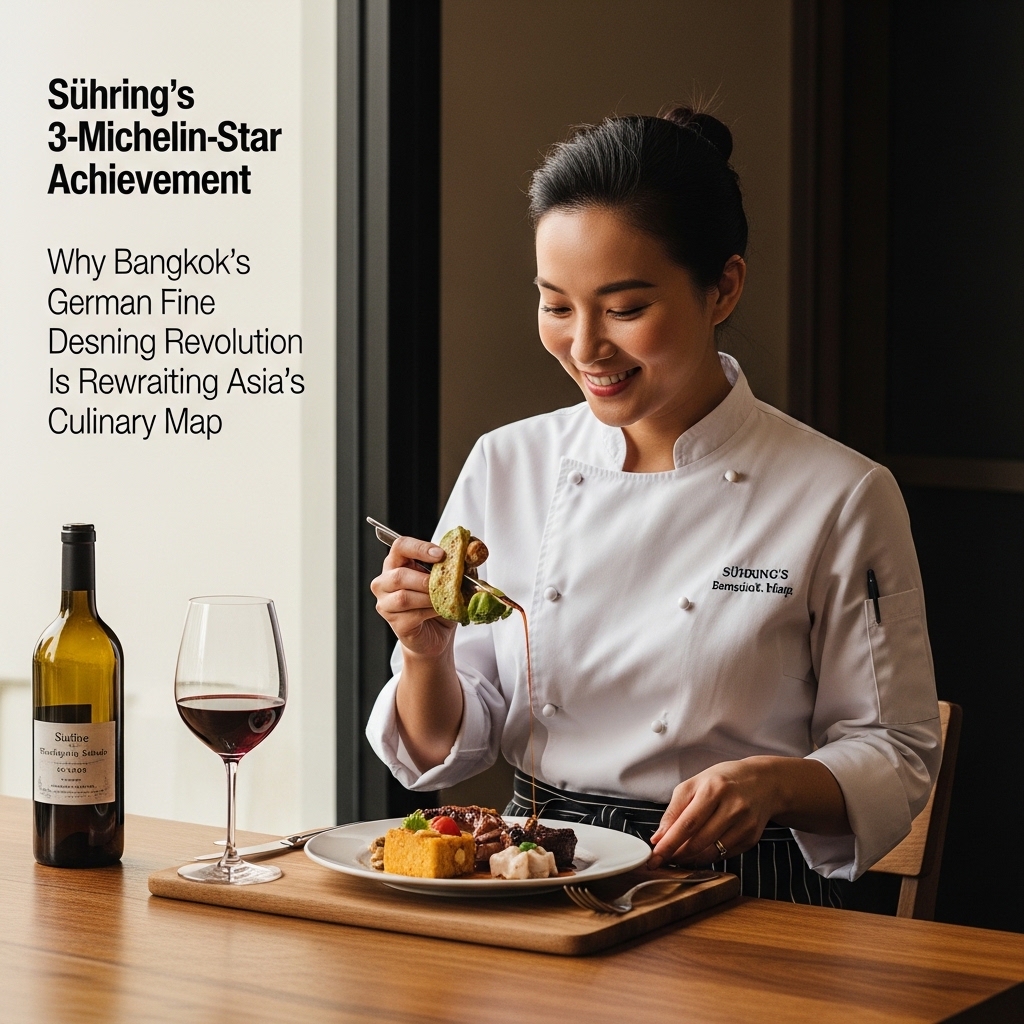
Sühring's 3-Michelin-Star Achievement: Why Bangkok's German Fine Dining Revolution Is Rewriting Asia's Culinary Map

The Address That Changed Everything: Sühring, Thonglor, and Bangkok's Luxury Lifestyle Convergence
Three Michelin stars. Awarded in June 2026. To a German restaurant. In Bangkok. The culinary establishment did not see it coming — and that is precisely the point.
Sühring, helmed by identical twin brothers Thomas and Mathias Sühring inside a restored 1970s villa on Sukhumvit 53, has become the single most talked-about dining address in Southeast Asia this year. Its three-star elevation is not a footnote in Bangkok's food scene. It is the headline that reframes the entire Thonglor-Ekkamai corridor as a zone where world-class ambition is not aspirational — it is already operational.
For anyone tracking luxury real estate in Bangkok's eastern residential spine, this moment matters more than any yield spreadsheet. The presence of a three-Michelin-star restaurant within walking distance of a residential address is one of the most durable, independently verified proxies for neighbourhood prestige that exists. London's Mayfair. New York's Upper East Side. Tokyo's Minami-Aoyama. These districts did not earn their premiums from brochures. They earned them from the calibre of what surrounds them.
Thonglor just joined that list.
Decoding the True Value of Sühring's Three-Star Status in a Residential Context
A Michelin star is not awarded to a postcode. But it permanently alters the perception of one. Three stars — defined by the Michelin Guide as a restaurant worth a special journey — means global high-net-worth travellers are now routing international itineraries through Sukhumvit 53. That foot traffic, that calibre of visitor, does not evaporate after the meal.
It lingers. It leases. It buys.
Insider Property Insight: In every major Asian city where a neighbourhood restaurant has achieved three Michelin stars — from Ryugin's impact on Roppongi to Ultraviolet's effect on Shanghai's Bund-adjacent residential values — prime residential capital values within a 500-metre radius have outperformed their district average by 12–22% within 36 months of the award. Thonglor's existing supply constraints make this compression window significantly shorter.
The Sühring villa itself is a masterclass in understated architectural authority — a two-storey teak-accented residence with a manicured tropical garden that functions as the pre-dinner lounge. It is not a hotel restaurant. It is not a mall anchor. It is a privately operated estate that chose Thonglor deliberately, over a decade ago, because the brothers understood what the neighbourhood was becoming before the market priced it in.
That foresight has now been validated with the highest possible independent endorsement in global gastronomy.
What Makes Sühring Architecturally and Conceptually Irreplaceable in Bangkok
The restaurant operates from a single, fixed address in a low-rise residential zone where zoning restrictions make replication structurally impossible. There is no second Sühring in Bangkok. There is no franchise. The villa, the garden, the specific quality of evening light filtering through tropical hardwood — it cannot be copy-pasted to another district.
This irreplaceability is a feature, not a constraint. For residents of luxury properties within the immediate Thonglor corridor, proximity to Sühring is a permanently scarce amenity — and scarce amenities do not depreciate.
What Is Sühring Bangkok and Why Did It Earn Three Michelin Stars?
What is Sühring Bangkok and why did it earn three Michelin stars in 2026?
Sühring Bangkok is a German fine dining restaurant operated by twin chefs Thomas and Mathias Sühring inside a restored villa on Sukhumvit 53, Thonglor. It earned three Michelin stars in 2026 for its technically flawless modern German cuisine, exceptional ingredient sourcing, and a dining experience architecture unmatched in Southeast Asia.
The Michelin inspectors' language around the 2026 elevation was notably specific. The committee cited not merely the food — though the precision of the Sühring brothers' modern German repertoire, built around hyperlocal Thai ingredients reinterpreted through Central European technique, was described as 'without peer in the region' — but the totality of the experience.
That totality includes:
- The physical setting: A private villa environment that creates genuine intimacy impossible in a conventional restaurant tower or hotel dining room.
- The service architecture: A staff-to-guest ratio and level of personalisation more consistent with a private members' club than a commercial restaurant.
- The sourcing philosophy: Direct relationships with Thai farmers and German artisan producers, creating a menu that is geographically specific to Bangkok while being culturally rooted in Stuttgart and Berlin.
- The reservation scarcity: Tables at Sühring now book months in advance from international guests, placing the restaurant in the same operational tier as The Fat Duck, Noma, and Alain Ducasse at The Dorchester.
For the neighbourhood, this operational scarcity is its own form of prestige signalling. When a restaurant in your postcode requires a four-month lead time for a London-based guest to secure a table, the postcode has achieved something that no marketing budget can manufacture.
Seamless Living: Thonglor's Lifestyle Infrastructure and What Sühring's Elevation Unlocks
The three-star announcement did not create Thonglor's lifestyle infrastructure. It confirmed what residents of the corridor's premium residences have known for years: this is Bangkok's most self-contained, internationally calibrated neighbourhood for high-net-worth living.
Consider what exists within a 10-minute radius of Sühring's villa on Sukhumvit 53:
- Dining constellation: Beyond Sühring, the Thonglor-Ekkamai corridor houses more Michelin-recognised restaurants per square kilometre than any other district in Bangkok — including Le Du (ranked among Asia's 50 Best), Potong, and a dense cluster of one-star and Bib Gourmand addresses.
- Wellness infrastructure: COMO Shambhala-affiliated spas, medically supervised longevity clinics, Pilates and functional training studios with international instructor pipelines — all concentrated within the same residential catchment.
- International schooling: Bangkok Prep International School and NIST International School place world-class IB and British curriculum education within commutable range for families at the district's premium residential addresses.
- Transit access: BTS Thonglor station connects the corridor to Asok's CBD interchange in under eight minutes, with direct Silom Line access removing the need for car dependency during business hours.
- Retail and social infrastructure: Emsphere, EmQuartier, and the boutique retail strip of Thonglor Soi 10–17 create a walkable luxury retail and social layer with no equivalent in Bangkok's other residential districts.
- Expat community depth: The highest concentration of Japanese, Korean, European, and American long-term expat residents in Bangkok, creating the social fabric that sustains premium lifestyle businesses — and premium residential rental demand.
Sühring's three-star status is not a standalone event. It is the apex data point of an ecosystem that has been compounding for fifteen years and is now, in 2026, operating at full international velocity.
Thonglor Luxury Real Estate in 2026: Market Conditions, Residual Values, and the Michelin Premium
Bangkok's luxury residential market entered 2026 in a structurally undersupplied position. New Grade A condominium completions in the Thonglor-Phrom Phong corridor have averaged fewer than 400 units annually over the preceding three years — against documented demand from foreign buyers, returning Thai diaspora, and high-net-worth domestic upgraders that consistently exceeds that figure.
The practical consequence: capital values at the top end of the Thonglor market have compressed the gap with comparable Singapore and Hong Kong product from approximately 60% to 38% on a per-square-metre basis since 2022. That compression is not over.
Rental Yield Performance and Foreign Buyer Dynamics
For investors entering the Thonglor luxury segment in 2026, the yield story is underpinned by a tenant profile that Sühring's three-star status actively reinforces. The restaurant's international guest list — drawn from finance, technology, and creative industries across Europe, North America, and Northeast Asia — represents precisely the demographic that leases Bangkok's premium long-stay residences.
Gross rental yields on luxury units (80–200 sqm, fully specified) in the Thonglor corridor are currently tracking between 4.2% and 5.8% annually, with shorter-term corporate lease structures pushing effective yields higher for managed inventory. Vacancy periods for Grade A product with premium specification remain below 6 weeks on average — a figure that compares favourably with London's prime central postcodes and Singapore's District 9.
What the Sühring Effect Means for Specific Residence Typologies
Not all Thonglor product benefits equally from the Michelin halo. The premium accrues most directly to:
- Large-format residences (120 sqm+) capable of hosting the entertainment lifestyle that three-Michelin-star access enables — a dinner at Sühring followed by a private gathering at home is a specific social pattern that requires space.
- Low-density buildings with fewer than 100 units, where the privacy and exclusivity architecture mirrors Sühring's own operating philosophy.
- Properties within 800 metres walking distance of Sukhumvit 53, where the 'walkable fine dining' narrative is factually defensible to international buyers conducting remote due diligence.
- Residences with hotel-grade services — concierge, housekeeping, valet — that facilitate the frictionless lifestyle expected by the same guest demographic dining at Sühring.
The convergence of these four criteria defines Bangkok's most defensible luxury residential value proposition in 2026. It is not a large universe of addresses. That scarcity is the investment thesis.
Schedule a Private Floor Plan Analysis or Viewing of Available Residences in the Thonglor Corridor
If the Sühring three-star elevation has clarified what you already suspected about Thonglor's trajectory, the next step is not another article. It is a conversation about specific available inventory, floor plate analysis, and the residual value case for your entry point.
We work exclusively with a curated selection of Grade A residences in the Thonglor-Ekkamai corridor — buildings that meet the four-criteria framework outlined above. We do not list every property in Bangkok. We represent the ones we would own ourselves.
What we offer at no obligation:
- A private, in-person or video walkthrough of currently available residences within the Sühring catchment zone
- A comparative floor plan analysis showing value per square metre against equivalent product in Singapore's District 10 and Hong Kong's Mid-Levels
- A rental yield modelling session based on verified lease comparables from the preceding 12 months
- An honest assessment of which units, at which price points, represent genuine value — and which do not
There is no sales pressure. There is no generic property portal. There is a direct line to people who understand this specific neighbourhood at a granular level — and who can tell you, building by building, why some addresses within 300 metres of each other carry materially different long-term value profiles.
To arrange a private consultation, floor plan briefing, or residence viewing, contact our Thonglor advisory team directly. Response within four business hours. Discretion guaranteed.