Condominiums in Bangkok 2026: A Foreigner's Definitive Guide to Secure Ownership Amidst Nominee Crackdowns

Why June 2026 Changed Everything for Foreign Condo Buyers in Bangkok
On June 12, 2026, Thailand's Department of Special Investigation formally announced a coordinated sweep targeting nominee shareholding arrangements used by foreign nationals to circumvent the Condominium Act's 49% foreign-ownership quota. Within 72 hours, seventeen registered companies in Bangkok's CBD had their property titles frozen pending investigation.
This was not a drill. Unlike previous warnings issued in 2019 and 2022 that quietly dissolved, this crackdown came with inter-agency coordination between the DSI, the Revenue Department, and the Anti-Money Laundering Office. Foreign buyers who had relied on Thai-national nominees holding majority shares in property-owning companies were suddenly sitting on legally contested assets.
The single safest response — and the one every credible Bangkok property lawyer is now prescribing — is a return to the only structure the Condominium Act has always genuinely protected: direct freehold title purchase within the legally defined foreign quota of a registered condominium building. No holding company. No nominee. No ambiguity.
Insider Insight: Bangkok's legitimate freehold foreign quota in Grade-A condominiums along the BTS Sukhumvit and Silom corridors was already running at 85–92% absorption rates before the June 2026 crackdown. Post-enforcement, demand for the remaining compliant quota units surged a further 18% in under four weeks, according to CBRE Thailand's Q2 2026 flash report. The window to secure clean title at pre-crackdown pricing is measurably narrow.
Decoding the True Value of Direct Freehold Condo Ownership in Bangkok
A freehold condo title granted under Section 19 of Thailand's Condominium Act B.E. 2522 is categorically different from every other property structure available to foreigners in the kingdom. The title — a Chanote deed bearing the specific unit number, floor, and building registration — is recorded in the foreign-owner's name directly at the Land Department. It is not mediated by a company, a lease agreement, or a trustee relationship of any kind.
This distinction is the entire ballgame in 2026. A 30-year lease, once considered a pragmatic alternative, now carries the forensic attention of AMLO investigators looking for disguised long-term ownership. A nominee company structure is, bluntly, a criminal liability. Only the Chanote freehold title stands on legally unassailable ground.
What Makes a Bangkok Condo Building's Foreign Quota Genuinely Safe?
Not all buildings advertising 'foreign quota units' are equal in structural integrity. Three factors separate a genuinely safe acquisition from a soft legal exposure:
- Registered Foreign Ownership Ratio: The building's juristic person must hold official Land Department records confirming current foreign ownership sits below 49% of total sellable area — not just unit count. Insist on seeing the actual registration document, not a developer's sales brochure claim.
- Funds Transfer Documentation: The purchase price must enter Thailand via a Foreign Exchange Transaction (FET) certificate, formerly known as a Thor.Tor.3. This single document is the legal spine of a foreigner's ownership claim. Any developer or agent suggesting you fund a purchase through a Thai bank account in a nominee's name is directing you toward an immediately invalidatable transaction.
- Building Age and Developer Track Record: Buildings completed before 2010 in Bangkok's prime corridors have established juristic committees with audited ownership records. Newer projects from developers with fewer than three completed Bangkok buildings carry higher administrative risk of quota mismanagement.
The buildings that meet all three criteria, consistently, sit in a very specific geography: the Sukhumvit corridor between stations Asok (E4) and Phrom Phong (E5), the Silom-Sathorn financial district, and the emerging Charoennakhon waterfront opposite the CBD.
Can Foreigners Own a Condo Outright in Bangkok?
Can Foreigners Own a Condo Outright in Bangkok?
Yes. Foreign nationals can own a Bangkok condominium outright in freehold under the Condominium Act, provided the building's aggregate foreign ownership does not exceed 49% of total floor area, and the purchase funds are remitted into Thailand in foreign currency with a verified Foreign Exchange Transaction certificate.
This is the cleanest, most legally robust property ownership structure available to non-Thai nationals anywhere in Southeast Asia — and in the post-June 2026 enforcement climate, it is the only structure Bangkok's top-tier property lawyers will now endorse without material caveat.
The Foreign Exchange Transaction Certificate: Your Ownership's Legal Spine
Every foreign buyer must request their receiving Thai bank to issue an FET certificate at the moment of inward remittance. This document records the foreign currency amount, the exchange rate applied, and the stated purpose of the transfer. Without it, the Land Department will not register the unit in a foreign name — and no amount of legal creativity will substitute for it after the fact.
Critically, the FET must be issued for the full purchase price including any transfer fee portions the buyer agrees to cover. Partial FET certificates covering only 90% of the transaction have been successfully challenged during title registration audits in Bangkok's Watthana and Bang Rak districts in 2025 and 2026.
- Remit from your own overseas account — not a Thai account held in a nominee's name
- Specify 'condominium purchase' as the transfer purpose with the receiving bank
- Retain the original FET certificate physically — it is irreplaceable and non-reissuable
- Ensure the remitted amount equals or exceeds the total contract price shown on the Sale and Purchase Agreement
Seamless Living: Proximity to Bangkok's BTS and MRT Network as a Condo Buyer's Primary Yield Driver
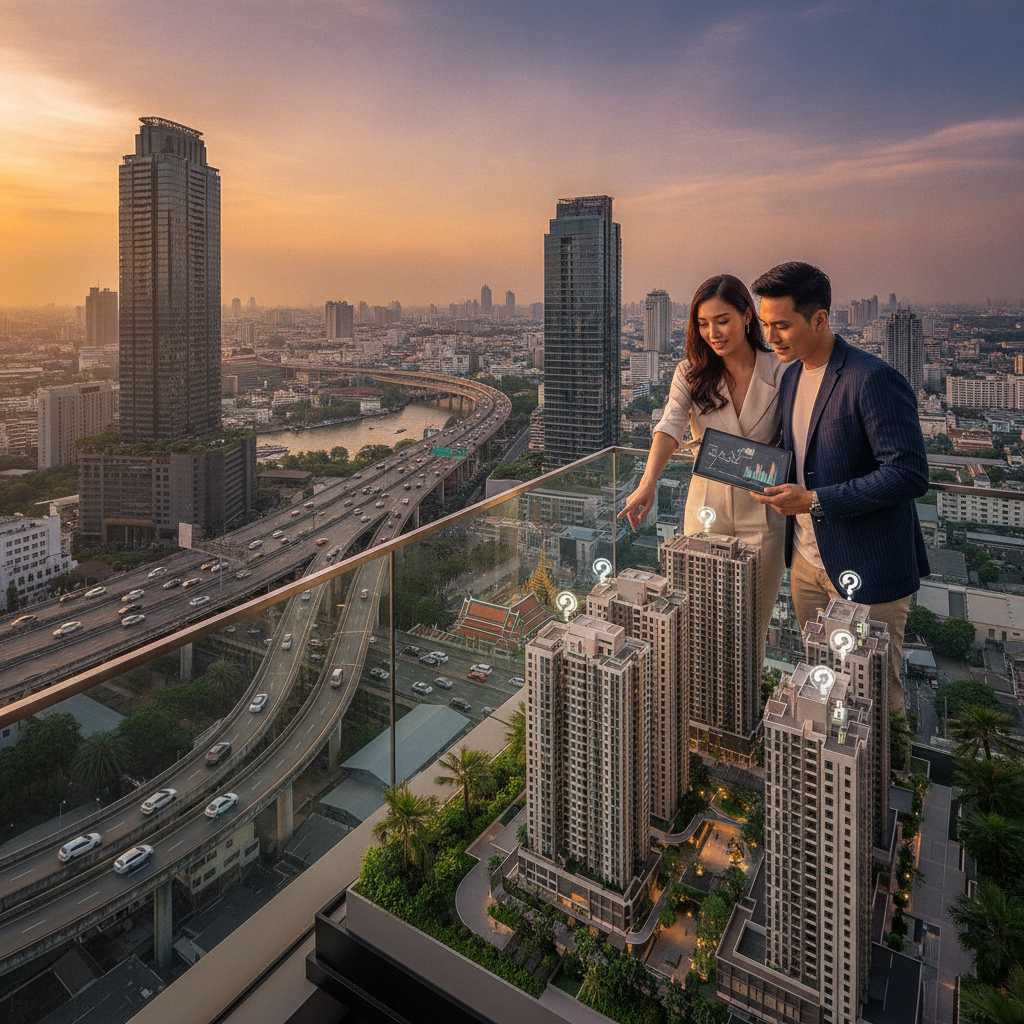
In every rental yield and capital appreciation analysis conducted by Knight Frank, CBRE, and Colliers Thailand between 2020 and 2026, one variable consistently outperforms all others in Bangkok's condominium market: distance to a BTS Skytrain or MRT subway station measured in walking minutes, not kilometers.
Units within a 300-meter walking radius of a Grade-A interchange station — Asok-Sukhumvit (BTS/MRT interchange), Siam (BTS interchange), or Sala Daeng-Si Lom (BTS/MRT interchange) — command a 22–31% rental premium over comparable units 600 meters away in the same postal district. For a foreign buyer seeking both yield and future liquidity when exiting the market, this premium is not cosmetic. It is the difference between a tenant queue and a vacancy.
The Specific Bangkok Corridors Worth Your Due Diligence in 2026
- Sukhumvit Soi 1–21 (Nana to Asok): Highest concentration of compliant foreign-quota buildings with active secondary market. Rental yield range: 4.8–6.2% gross. Primary tenant base: Japanese, Korean, and European corporate expats on company-leased contracts of 12–24 months.
- Sukhumvit Soi 24–49 (Phrom Phong to Thong Lo): Bangkok's most premium residential corridor. Lower yield (3.9–5.1% gross) but strongest capital preservation and appreciation record over 10-year periods. Foreign quota in the best buildings here is functionally exhausted — secondary market only.
- Silom-Sathorn (Chong Nonsi to Surasak): Financial district proximity drives weekday rental demand from banking and legal sector professionals. Mixed-use density creates the strongest short-stay and serviced apartment conversion potential in the city.
- Charoennakhon (Gold Line BTS): The only prime waterfront corridor where new freehold foreign quota remains available in newly completed buildings. River-view units are attracting significant interest from Hong Kong and Singapore-based buyers diversifying out of dollar-pegged assets.
The non-negotiable rule: if a building is more than a 10-minute walk from a BTS or MRT station with no shuttle service and no immediate infrastructure upgrade scheduled, it does not belong in a foreign investor's Bangkok portfolio regardless of how attractive the per-square-meter price appears.
Safe Condo Investment for Foreigners: Market Conditions, Layouts, and Realistic Rental Yields in 2026
Bangkok's prime condominium market entered 2026 in a condition that confounds casual observers: supply of new completions is tightening precisely as qualified demand from foreign buyers is intensifying. The post-crackdown flight to legitimate freehold title has compressed the pool of genuinely compliant units available for foreign purchase into a smaller, more competitive subset of the market than at any point in the past decade.
Unit Layout Realities for Foreign Buyers Targeting Rental Income
The Bangkok rental market has a clear and consistent verdict on unit sizing: one-bedroom units of 35–52 square meters generate the highest yield-to-cost ratio across every prime corridor. They lease fastest, stay occupied longest, and attract the most creditworthy tenant profile — the single relocating professional or couple on a corporate package.
- Studio units (22–30 sqm): High turnover, lower rent ceiling, harder to retain tenants beyond 6 months. Best suited to platforms targeting short-stay rental — a segment facing its own regulatory uncertainty in Bangkok post-2025.
- One-bedroom units (35–52 sqm): The Bangkok rental market's institutional-grade product. Gross yields of 5.0–6.2% achievable in Sukhumvit and Silom prime. Tenant tenure averaging 14 months per tenancy in managed buildings with active building management.
- Two-bedroom units (65–90 sqm): Longer void periods between tenancies but significantly higher absolute monthly rental income. Appropriate for buyers prioritizing capital growth over immediate yield maximization.
- Penthouse and duplex units (120 sqm+): Illiquid rental market. Appropriate only as a primary residence or as a capital appreciation vehicle in buildings with strong brand equity and exclusive market positioning.
The Nominee Crackdown's Specific Impact on Pricing
The June 2026 enforcement action is creating a two-speed market. Buildings where a significant proportion of the Thai-quota units were held through nominee structures — now frozen or under investigation — are experiencing price uncertainty in both the Thai-quota and foreign-quota segments as buyers apply a compliance discount to the entire building's title history.
Buildings with clean, auditable ownership records and no DSI-flagged transactions are, conversely, trading at a measurable premium as buyers compete for verified compliance. This bifurcation will deepen through the remainder of 2026 and is likely to be permanent. Buying on price alone, without a full title history audit, is no longer a defensible strategy in Bangkok's post-crackdown environment.
Market Intelligence: Bangkok property lawyers at three of the city's top five international firms report a 340% increase in foreign client requests for retrospective nominee structure unwinding since June 2026. The legal cost of dissolving an improperly structured arrangement now frequently exceeds 15% of the asset's market value when penalties, back taxes, and transfer costs are totalized — making prevention categorically cheaper than cure.
Investment Tips for Foreign Condo Buyers in Bangkok: 2026 Checklist
- Commission an independent title search through a licensed Thai lawyer — not the developer's recommended legal counsel — before signing any reservation agreement
- Verify the building's current foreign ownership percentage directly with the juristic person's office, not via the developer's sales team
- Remit all funds from a personal overseas account and obtain your FET certificate before the Land Department registration appointment
- Engage a property management company with a verifiable track record in your specific target building before purchase, not after
- Request audited accounts from the building's juristic committee for the past three fiscal years — maintenance fund solvency is a direct predictor of building condition and future capital value
- Avoid any agent, lawyer, or developer who suggests that nominee structures, lease agreements 'with purchase options,' or offshore company ownership are viable 2026 alternatives to direct freehold title
Schedule a Private Floor-Plan Analysis and Compliant Purchase Consultation
The Bangkok condominiums that satisfy every criterion in this guide — verified foreign quota availability, clean title history, BTS or MRT walking distance under 300 meters, and buildings with no DSI-flagged ownership records — represent a specific, finite set of assets. That list is shorter in July 2026 than it was in January 2026, and it will be shorter still by year's end.
We work exclusively with foreign nationals navigating Bangkok's freehold condominium market. We do not list every building in the city. We list the ones we can defend to a Thai land lawyer and a foreign tax adviser simultaneously.
If you are ready to move from research to a verified shortlist of compliant units matched to your budget, target yield, and preferred corridor, the next step is a private floor-plan analysis session — no sales pressure, no nominee structure suggestions, no wasted weekends.
- What you receive: A curated selection of 3–5 units in buildings that pass our full compliance audit, with current asking prices, foreign quota availability confirmation, and projected gross yield ranges
- What it costs: Nothing. Our fee structure is fully transparent and disclosed before any viewing is arranged
- How to begin: Submit your budget range, preferred corridor, and target move-in or investment timeline using the contact form below
Request your private floor-plan analysis now — the compliant foreign quota in Bangkok's prime corridors is not waiting for a more convenient moment.