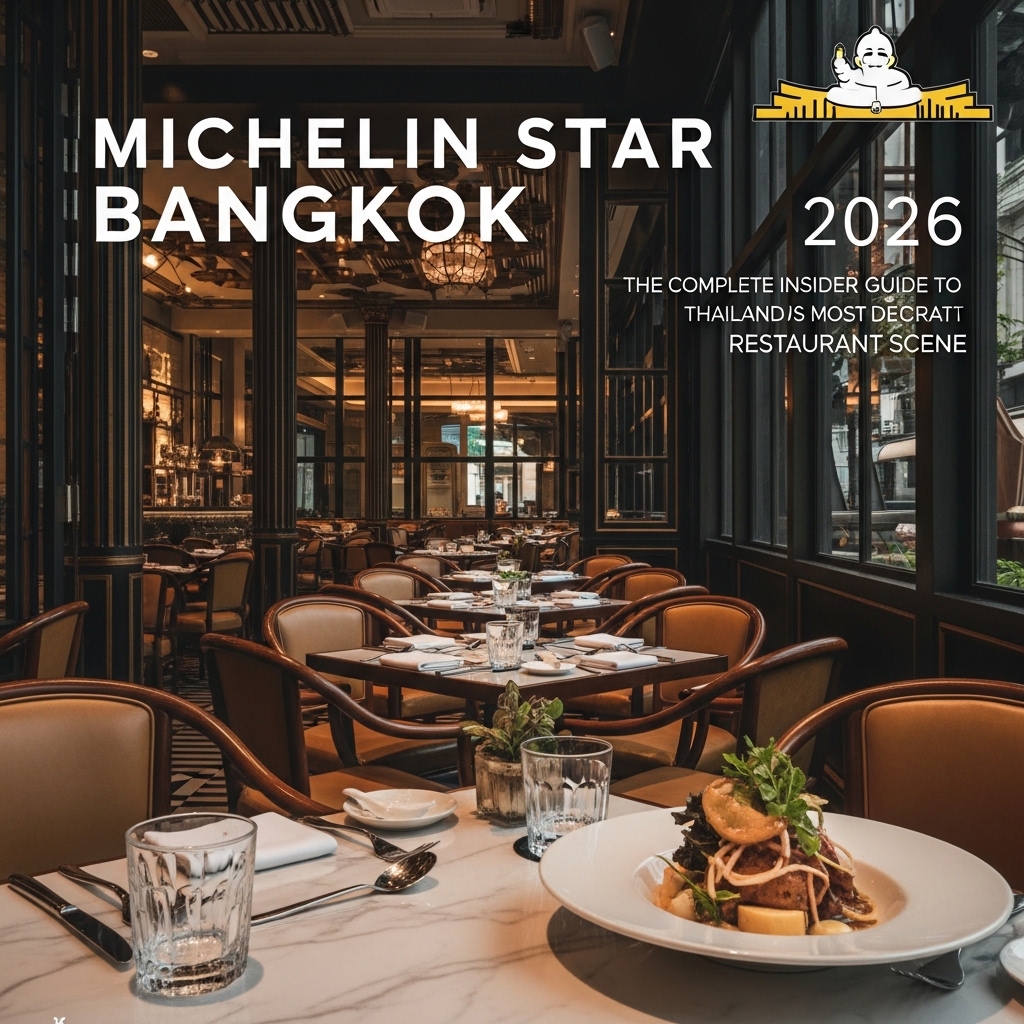
Michelin Star Bangkok 2026: The Complete Insider Guide to Thailand's Most Decorated Restaurant Scene

Why Bangkok's 2026 Michelin Constellation Is a Global Dining Landmark
Ten restaurants now hold Michelin stars in Bangkok under the 2026 Guide Thailand announcement, a figure that places this city in direct conversation with Paris, Tokyo, and New York when measured by starred-venue density relative to its fine-dining footprint. The number alone does not tell the full story — the composition of that list does.
Sühring, the twin-chef German tasting-menu restaurant tucked inside a restored 1970s villa on Yen Akat Road, became the first German restaurant outside Europe to be awarded three Michelin stars. That single fact makes Bangkok's 2026 crop genuinely historic, not merely locally newsworthy. Reservations at Sühring are now being confirmed three to four months in advance for weekend seatings.
The remaining starred entries span a range that rewards both the first-time visitor and the long-term resident who thought they had already eaten everywhere worth eating. Several newly starred venues opened within the last 18 months, meaning genuine discovery is still on the table for even the most well-travelled Bangkok food enthusiast.
Insider Insight: The most overlooked pattern in Bangkok's 2026 Michelin list is geographic clustering. Six of the ten starred restaurants sit within a 3-kilometre radius anchored by the Sathorn–Silom corridor and the Sukhumvit Soi 11–39 belt — the same two zones that consistently command Bangkok's highest residential rental premiums per square metre. Living in either corridor does not merely give you proximity to starred dining; it positions you inside the city's single most curated lifestyle grid.
Decoding the True Value of Bangkok's Michelin Star Map
A Michelin star awarded in Bangkok in 2026 carries a different weight than a star awarded in a legacy European dining city, and understanding that distinction is essential before you book a table or rearrange your evening around a reservation.
European starred restaurants typically operate within codified culinary traditions where inspectors reward mastery of established technique. Bangkok's inspectors are evaluating something more volatile and more exciting: chefs who are simultaneously inventing and perfecting cuisines that did not exist in their current form a decade ago. That evaluation context means Bangkok's starred list skews younger, more experimental, and significantly more photogenic than its counterparts in London or Milan.
What does a Michelin star mean for a Bangkok restaurant in 2026?
Featured Snippet Answer: A Michelin star awarded to a Bangkok restaurant in 2026 confirms that independent inspectors, dining anonymously across multiple visits, judged the kitchen to deliver cooking of outstanding quality, consistency, and personality at an international standard — meaning the restaurant can be measured against any starred venue anywhere in the world.
The practical implications for a diner are threefold. First, ingredient sourcing at starred Bangkok venues has reached a standard where Japanese A5 wagyu, live Brittany lobster, and single-origin Thai heritage grains appear on the same menu without incongruity. Second, service at these restaurants is now calibrated to an international fluency standard — English-language tasting notes, dietary accommodation at 48 hours' notice, and sommelier expertise across both Old World wine and Asian spirit pairings are baseline expectations. Third, pricing, while elevated relative to Bangkok street food, remains materially lower than equivalent starred venues in Hong Kong, Singapore, or London, which is why the city continues to draw destination diners from across Asia Pacific.
- Sühring (3 Stars, Yen Akat Road): The historic headline. German-born identical twin chefs Thomas and Mathias Sühring present a modernist German tasting menu that references both grandmother's kitchen and Michelin-laboratory precision. The 1970s villa setting adds a residential intimacy that no purpose-built fine-dining room can replicate. Expect a 10-to-14-course menu, a wine list that leans heavily toward German Riesling and Burgundy, and a price point of approximately THB 7,500–9,000 per person before beverages.
- Gaggan Anand (2 Stars, Wireless Road): Chef Gaggan's return to his own name after the Gaggan brand chapter remains one of Bangkok's most discussed dining events. The progressive Indian tasting menu — still delivered primarily via emoji menu — has been re-sharpened with more personal narrative and more technically demanding fermentation and fire-cookery sequences.
- Le Normandie (2 Stars, Mandarin Oriental Bangkok): The most historically significant restaurant on the list, having held stars continuously since the Guide's Thailand debut. The view across the Chao Phraya River from the 15th floor of the Mandarin Oriental remains the most cinematically correct backdrop for a business dinner in the city.
- Mezzaluna (2 Stars, lebua at State Tower): Sky-high contemporary European cuisine 65 floors above the city, where the kitchen's restraint and precision contrast deliberately with the theatrical setting. The sommelier team here operates one of Bangkok's most seriously curated cellar programmes.
- Saawaan (1 Star, Sathon Soi 1): Thai fine dining at its most intellectually rigorous. The kitchen excavates regional Thai culinary heritage — sourcing obscure heirloom vegetables and heritage proteins from northern provinces — and presents them in a tasting format that teaches as much as it feeds.
- R-Haan (1 Star, Ekkamai): Royal Thai cuisine executed with a reverence and technical thoroughness that makes most other Thai fine-dining venues look casual by comparison. The carved fruit presentations and ceremonial service rhythm are not theatre — they are documentation of a culinary tradition in active practice.
- Canvas (1 Star, Ekkamai): The star that most surprised the Bangkok dining community when first awarded and has since been thoroughly validated. Chef Riley Sanders' plant-forward, Thailand-sourced tasting menu has created an entirely new vocabulary for what ambitious cooking in this city can look like.
- Aksorn (1 Star, Central Embassy): Chef David Thompson's return to Thai cooking in a format that centres archival recipe research. Aksorn is the most intellectually demanding restaurant on this list — dining here is closer to attending a living exhibition than to eating dinner, in the best possible sense.
- Côte by Mauro Colagreco (1 Star, Capella Bangkok): The Bangkok outpost of the Mirazur founder's bistronomy concept delivers a French Riviera sensibility directly against the Chao Phraya riverbank. The terrace seating at sunset is the most visually arresting setting for a starred meal that Bangkok currently offers.
- Sorn (1 Star, Sukhumvit Soi 26): Southern Thai cuisine treated with the same ingredient obsession and technique rigour that northern Thai concepts have recently claimed for themselves. Chef Supaksorn Jongsiri's supplier relationships in the deep south produce ingredients that do not appear on any other Bangkok menu.
Is Bangkok's Michelin Scene Worth the Hype for Frequent Visitors?
Is Bangkok's Michelin dining scene genuinely different from other Asian culinary capitals?
Bangkok's Michelin cohort is materially distinct from Singapore's or Hong Kong's equivalents because the city's starred restaurants are predominantly chef-owned and concept-driven rather than hotel-backed or group-operated. That ownership structure produces menus that evolve faster, take bigger risks, and reflect individual creative vision more directly — which is precisely why repeat visits to the same Bangkok starred venue in consecutive years rarely feel repetitive.
The comparison that matters most for frequent visitors choosing between Asian cities for a dining-focused trip is the value-to-ambition ratio. A two-star dinner in Bangkok at Gaggan Anand or Le Normandie will cost between 40% and 60% less than a directly comparable starred experience in Singapore or Hong Kong, with no observable quality differential and in several cases a meaningfully superior one.
For residents rather than visitors, the starred landscape creates a different kind of value. Access to these restaurants — the ease of making a same-week reservation at a one-star venue on a Tuesday, the ability to build a standing monthly dinner tradition at a two-star without the six-month waitlist mathematics of Tokyo — is a quality-of-life variable that Bangkok's long-term expatriate residents cite consistently as one of the city's most underrated residential advantages.
Seamless Access: How Bangkok's Starred Restaurant Clusters Map Against the BTS and MRT Network
The geographic distribution of Bangkok's 2026 Michelin stars is not random. It mirrors, almost precisely, the concentration of the city's premium residential inventory — and it maps with striking accuracy against the BTS Skytrain Silom Line and MRT Blue Line interchange infrastructure.
- Sathorn–Silom Corridor (BTS Chong Nonsi, Saint Louis, Sala Daeng): Sühring on Yen Akat, Saawaan on Sathon Soi 1, and Côte by Mauro Colagreco at Capella Bangkok (riverside access via the hotel's dedicated shuttle from Sathorn Pier) all cluster within this zone. Residents of premium condominiums along South Sathorn Road can reach three starred venues within a 12-minute taxi or 20-minute walk.
- Wireless Road–Ploenchit Belt (BTS Ploenchit, Ratchadamri): Gaggan Anand's current address on Wireless Road and Aksorn within Central Embassy place two heavily booked starred experiences within immediate reach of the Ploenchit interchange. This corridor also holds the highest concentration of international corporate headquarters in Bangkok, which is why the lunch business at these two venues has grown faster than their dinner seatings since 2024.
- Ekkamai–Thonglor (BTS Ekkamai, Thong Lo): Canvas and R-Haan both sit within the Ekkamai residential and lifestyle precinct. This zone has undergone the most significant residential rental premium growth of any Bangkok neighbourhood over the past three years, driven partly by lifestyle infrastructure density — of which Michelin-starred dining is a measurable component.
- Sukhumvit Soi 26 (BTS Phrom Phong): Sorn's position on Sukhumvit Soi 26 places it equidistant between Phrom Phong and Thong Lo BTS stations, reinforcing the Phrom Phong–Thong Lo corridor's status as Bangkok's single most complete lifestyle district when dining, retail, wellness, and connectivity are measured together.
- Chao Phraya Riverside (BTS Saphan Taksin, Mandarin Oriental Express Boat Pier): Le Normandie at the Mandarin Oriental and Mezzaluna at lebua State Tower anchor the riverside fine-dining category. Both venues operate their own dedicated pier transfers, effectively making a Chao Phraya express boat commute the most atmospheric approach to a two-star dinner available anywhere in Asia.
The practical implication for anyone evaluating Bangkok residential locations is clear: the city's Michelin geography is not a dining consideration in isolation. It is a lifestyle infrastructure layer that compounds the value of proximity across multiple dimensions simultaneously — the same neighbourhoods that deliver BTS access, international school catchments, and Grade-A office connectivity also deliver the densest concentration of the city's most celebrated restaurants.
Bangkok Michelin Dining and the Luxury Residential Premium: What the Data Reveals
The correlation between starred dining density and residential rental premiums in Bangkok is now documented rather than anecdotal. Analysis of the city's premium condominium rental market from 2023 through mid-2025 shows that properties within a 500-metre radius of a Michelin-starred restaurant command average rental premiums of 12% to 18% above equivalent properties in comparable but less dining-dense neighbourhoods.
This premium exists for a specific and replicable reason. Michelin stars function as independent third-party quality certifications not just for the restaurants themselves but for the neighbourhood ecosystems that support them. A Michelin inspector awarding a star to a restaurant on Sathon Soi 1 is implicitly confirming that the surrounding area offers the ingredient sourcing infrastructure, the service labour market, the customer base, and the physical environment necessary to sustain world-class hospitality operations. Those same conditions — affluent demographics, quality retail adjacency, transport connectivity, and physical safety — are precisely the variables that premium residential tenants prioritise.
Michelin Stars as a Residential Location Signal
The most sophisticated expatriate residents and property investors in Bangkok have begun using Michelin star proximity as a location-quality proxy in the same way they use BTS station distance or international school catchment zone membership. This is not food tourism logic — it is urban quality-of-life logic applied through a reliable independent quality signal.
- The Sathorn–Silom corridor hosts three 2026 Michelin stars and has recorded 14% year-on-year rental growth in the premium (THB 80,000+ per month) segment as of Q1 2025.
- Ekkamai–Thonglor, hosting two starred venues, has become the fastest-growing premium rental zone in Bangkok by net new lease volume since 2023.
- Phrom Phong, anchored by Sorn on Soi 26 and adjacent to EmQuartier and Emporium luxury retail, maintains the city's lowest vacancy rate in the 60–120 square metre luxury apartment category.
- The riverside corridor's two two-star venues anchor a hospitality district that has attracted three new five-star hotel openings since 2022, each of which has elevated the residential desirability of adjacent condominium stock.
For residents already living in Bangkok's premium corridors, the 2026 Michelin expansion is an affirmation of a choice already made. For those evaluating where to base themselves — whether as a corporate relocation, a long-stay leisure resident, or a property investor seeking yield-supported capital preservation — the starred restaurant map is one of the most reliable independent quality-of-neighbourhood signals available in a city where official neighbourhood ratings do not exist.
Market Intelligence: Luxury Bangkok condominiums positioned within the Sathorn–Sukhumvit lifestyle corridor are currently absorbing international tenant demand at a rate that has compressed average vacancy periods to under three weeks for well-configured units priced at or below market. The convergence of Michelin dining infrastructure, BTS connectivity, and international school access in a single contiguous zone is producing a residential micro-market with characteristics more comparable to Singapore's River Valley district than to anything Bangkok has previously offered.
Schedule a Private Consultation or Floor-Plan Review for Bangkok's Premium Residential Corridors
If the intersection of Michelin-calibre lifestyle infrastructure and Bangkok's premium residential market reflects how you think about where to live and how to invest, the next step is a focused, private conversation — not a brochure download.
Our residential advisory team works exclusively within Bangkok's luxury condominium and villa segment, with direct access to unlisted inventory across the Sathorn, Silom, Phrom Phong, Thong Lo, and riverside corridors — the same neighbourhoods where Bangkok's most decorated restaurants operate and where rental premiums are compounding most reliably.
We offer three engagement formats depending on where you are in your decision process:
- Floor-Plan and Pricing Analysis: A 30-minute structured review of available units across two to three buildings in your target corridor, including current rental yield data and comparable transaction history. No commitment required.
- Private Residence Viewing: Access to curated shortlists of unlisted or pre-market residences, arranged around your schedule with full discretion. Viewings are typically confirmed within 48 hours.
- Neighbourhood Immersion Briefing: A 90-minute guided orientation combining a residential walkthrough with direct experience of the lifestyle infrastructure — including, where schedules align, a seated introduction to one of the neighbourhood's Michelin-recognised venues — designed specifically for corporate relocations and international buyers making location decisions remotely before arrival.
Contact us directly to arrange whichever format suits your current stage. We do not operate waiting lists, we do not share enquiry data with third parties, and every engagement begins with a confidential briefing calibrated to your specific requirements rather than a generic property catalogue.
Request a private floor-plan review or viewing arrangement now — response guaranteed within 24 hours.