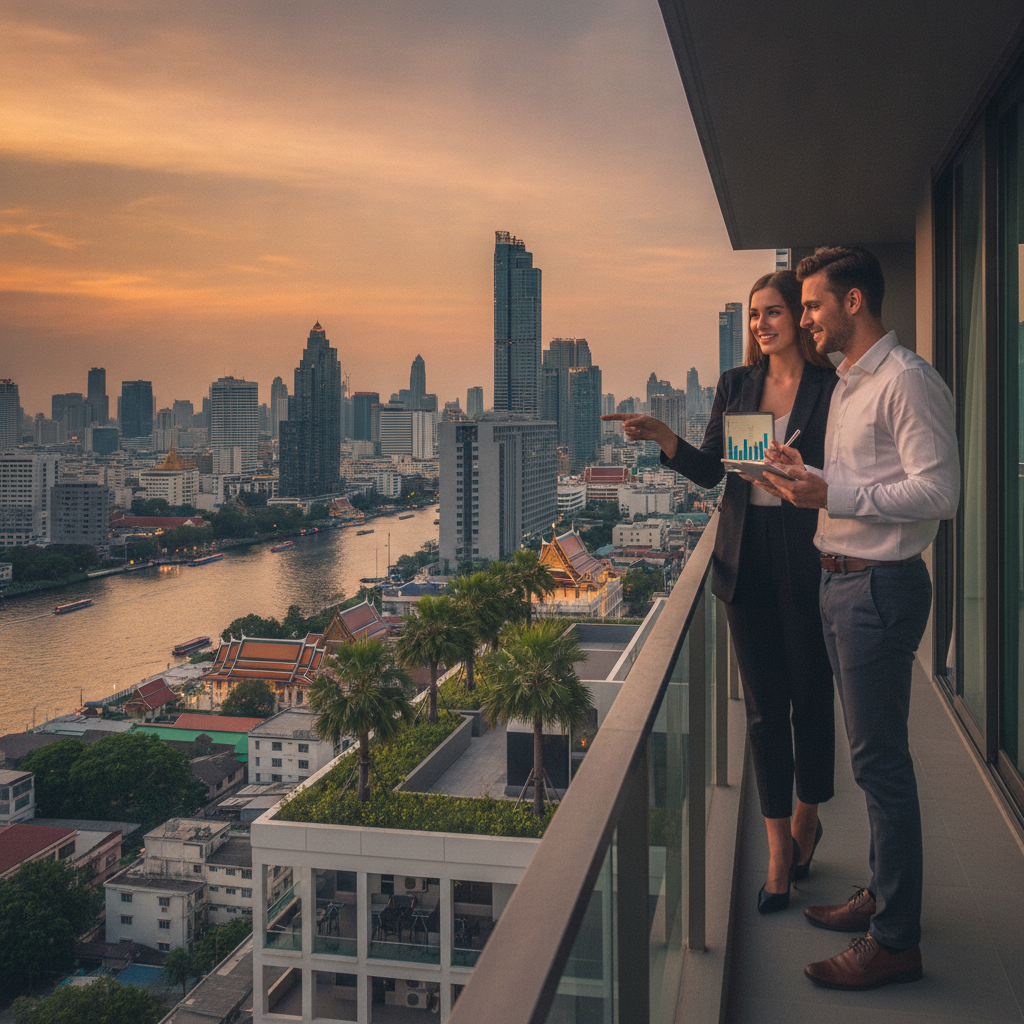
Beyond the Bling: Unpacking Bangkok's Real Estate Returns – Net Rental Yields and Capital Appreciation in 2026

The Numbers Bangkok Developers Don't Put on Billboards
Gross rental yield figures look great on a brochure. What they rarely show you is net yield after juristic fees, property management, vacancy gaps, and maintenance — the number that actually lands in your account.
In Q1 2026, new Bangkok condominiums are priced at an average of 85,000–130,000 THB per square meter (approximately USD 2,300–3,500). That is 40–55% below comparable units in major Western European capitals, making Bangkok one of the few markets where entry price, yield, and lifestyle quality still converge in the investor's favour.
But not all Bangkok postcodes perform equally. Where you buy — and what type of asset you buy — determines whether your investment compounds or stagnates. The data is clear, and it points in two very different directions.
CBD vs. Outer BTS Corridors: Where Bangkok Rental Yields Actually Land in 2026
What is the average rental yield for condominiums in Bangkok in 2026?
Bangkok condominium gross rental yields in 2026 average 4.5–5.5% in the CBD (Sukhumvit, Silom, Sathorn) and 6–7% in outer BTS/MRT corridors such as On Nut, Bearing, Bang Na, and Ari. Net yields after all costs land at approximately 3.5–5.2% in central districts.
Central Business District: Sukhumvit, Silom, Sathorn
Investors targeting Sukhumvit, Silom, and Sathorn should expect gross yields of 4.5–5.5%, compressing to net yields of approximately 3.5–5.2% after juristic fees, management, and vacancy allowances.
What the CBD trades in yield, it pays back in stability. Vacancy rates for quality condominiums in these central districts sit at just 8–12%, with occupancy exceeding 90%. Capital appreciation has historically tracked at 3–5% per year — a compounding story that outer districts rarely replicate.
The tenant base here is corporate expatriates and digital nomads: reliable payers on company leases who renew consistently. In Q1 2026, existing luxury and super-luxury supply in the CBD is recording 93–95% sales rates — a figure that underscores a market-wide flight to quality even as the mass-market segment struggles with a 24.3% sales rate on new launches.
Insider insight: The divergence between CBD luxury and mass-market condo performance in 2026 is the widest Bangkok has seen in a decade. Developers are actively targeting cash buyers — including foreign nationals — in the premium segment, which is creating rare off-market opportunities for investors who move quickly on existing, fully-occupied inventory.
Outer Corridors: On Nut, Bearing, Bang Na, Ari
For investors whose primary mandate is income yield over capital growth, the BTS and MRT corridors beyond the immediate city centre tell a compelling story. Districts including On Nut, Bearing, Bang Na, and Ari are generating gross yields of 6–7% — the highest in Bangkok by a significant margin.
The Yellow Line extension connecting to BTS Bearing has materially improved commute times and elevated the rental appeal of the Bang Na corridor. Lower purchase prices relative to rental demand are the mechanical driver here — not speculative momentum.
The BTS Silom Line stations at Talat Phlu and Wutthakat offer a third path: central connectivity at substantially lower condo prices than Sukhumvit, with a stable Thai tenant base including government workers and hospital employees. Investors who underwrite these assets correctly and manage them professionally are capturing net yields that the CBD cannot match.
The Bangkok Lifestyle Premium: What Your Tenants Are Actually Paying For
Understanding what attracts and retains high-quality tenants in Bangkok is as important as understanding the yield table. The lifestyle infrastructure surrounding a property is, in practical terms, an occupancy risk management tool.
- Dining at the top tier: The World Gourmet Festival 2026 at Anantara Siam Bangkok Hotel (Ratchadamri) draws international chefs for multi-course collaborative tasting menus — this is the culinary calendar that corporate tenants reference when evaluating relocation packages. The Chilli Fest 2026 at Kimpton Maa-Lai Bangkok (Chidlom/Langsuan) showcases Michelin-recognised restaurants in one venue, placing the Chidlom corridor at the centre of Bangkok's dining conversation.
- The Central Embassy and Central Chidlom corridor hosts the World in One Bite 2026 festival — over 150 leading restaurants and 120 food pop-ups — cementing this stretch as the city's most activated retail-dining precinct and a primary draw for high-spending residents.
- Active lifestyle infrastructure: Bangkok's running scene is rapidly growing, with free social clubs including Sabai Run Club, SarDine Run Club, and the Ugly Running Training Club operating from Lumphini and Benjakitti Parks (now connected by an elevated walkway). Rooftop yoga sessions, including King Power Mahanakhon's Yoga in the Sky on the 78th floor, provide wellness programming that tenants factor into neighbourhood selection.
- Night market culture: Jodd Fairs Ratchada (new 2026 location near MRT Cultural Centre) is currently Bangkok's most trafficked night market — its proximity to MRT access points makes surrounding residential assets demonstrably easier to rent. Asiatique The Riverfront and Train Night Market Srinakarin serve distinct tenant personas, from families to vintage collectors.
- Major events calendar: The Weeknd's After Hours Til Dawn Stadium Tour at Rajamangala National Stadium (11–13 October 2026) and Post Malone's BIG ASS Stadium World Tour (22 September 2026) signal the calibre of international entertainment Bangkok now hosts — a direct signal to relocating executives that the city's cultural offer is world-class. The BICT Fest 2026 at One Bangkok (21–30 August) underlines the city's growing family arts programming for residents with children.
- Family and school zoning: The Sukhumvit corridor (Phrom Phong, Thong Lo, Ekkamai) remains the primary address for corporate expatriates with families, offering proximity to international school communities, family-friendly amenities, and — critically — the highest resale liquidity of any Bangkok district.
The 2026 Policy Shifts Every Bangkok Property Investor Must Know
Market returns do not exist in a policy vacuum. Two regulatory developments in 2026 are reshaping the Bangkok investment landscape in ways that create both risk and opportunity.
Property Fee Cuts Extended to June 2027
The Thai Cabinet has extended transfer fee reductions from 2% to 0.01% and mortgage registration fees from 1% to 0.01% on properties valued up to 7 million baht. This measure, effective from 1 July 2026 to 30 June 2027, applies to registered condominium units and is actively stimulating transfer activity among Thai individual buyers.
For investors managing portfolio exits or structuring secondary-market transactions below the 7 million baht threshold, this window meaningfully reduces the friction cost of a sale and broadens the buyer pool.
Nominee Structures Are Now a Liability, Not a Loophole
Since 2025, Thai authorities have significantly intensified scrutiny of nominee ownership structures. In June 2026, the Land Department expanded data-sharing with the Department of Business Development (DBD), making shell-company and Thai-nominee arrangements materially riskier to maintain.
For foreign investors, the compliant path remains clear: freehold condominium purchases within the 49% foreign ownership quota or properly structured long-term leaseholds. Any investment thesis built on a grey-zone structure now carries regulatory risk that no yield premium can justify.
The practical implication for 2026: foreign capital is consolidating into premium freehold condominiums in the CBD — precisely the segment showing 93–95% occupancy. Scarcity within the foreign quota in desirable buildings is a supply constraint that supports both rental pricing and capital values.
Request a Private Yield Analysis for Your Target Bangkok District
Bangkok's rental yield and capital appreciation data in 2026 rewards specificity. The difference between a 3.5% net yield and a 5.2% net yield — on the same street — comes down to asset selection, lease structuring, and management quality.
If you are evaluating a specific building, floor plate, or district and want a forensic breakdown of realistic net returns, vacancy assumptions, and capital growth trajectory, we can build that analysis for you — privately, with no obligation.
Contact our investment advisory team to arrange a one-on-one floor-plan and yield review session. We work with a curated selection of CBD and outer-corridor assets that meet our own underwriting standards — the same standards reflected in the data above.
Arrange your private Bangkok property yield consultation today. Tell us your target district, budget range, and income or appreciation mandate — and we will respond with a specific, numbers-first recommendation within 24 hours.