Yellow Line Revolution: How Bangkok's New BTS Extension Is Reshaping Rental Yields in Bangna and Udomsuk

Why Bangna and Udomsuk Suddenly Make Sense for Yield-Focused Investors
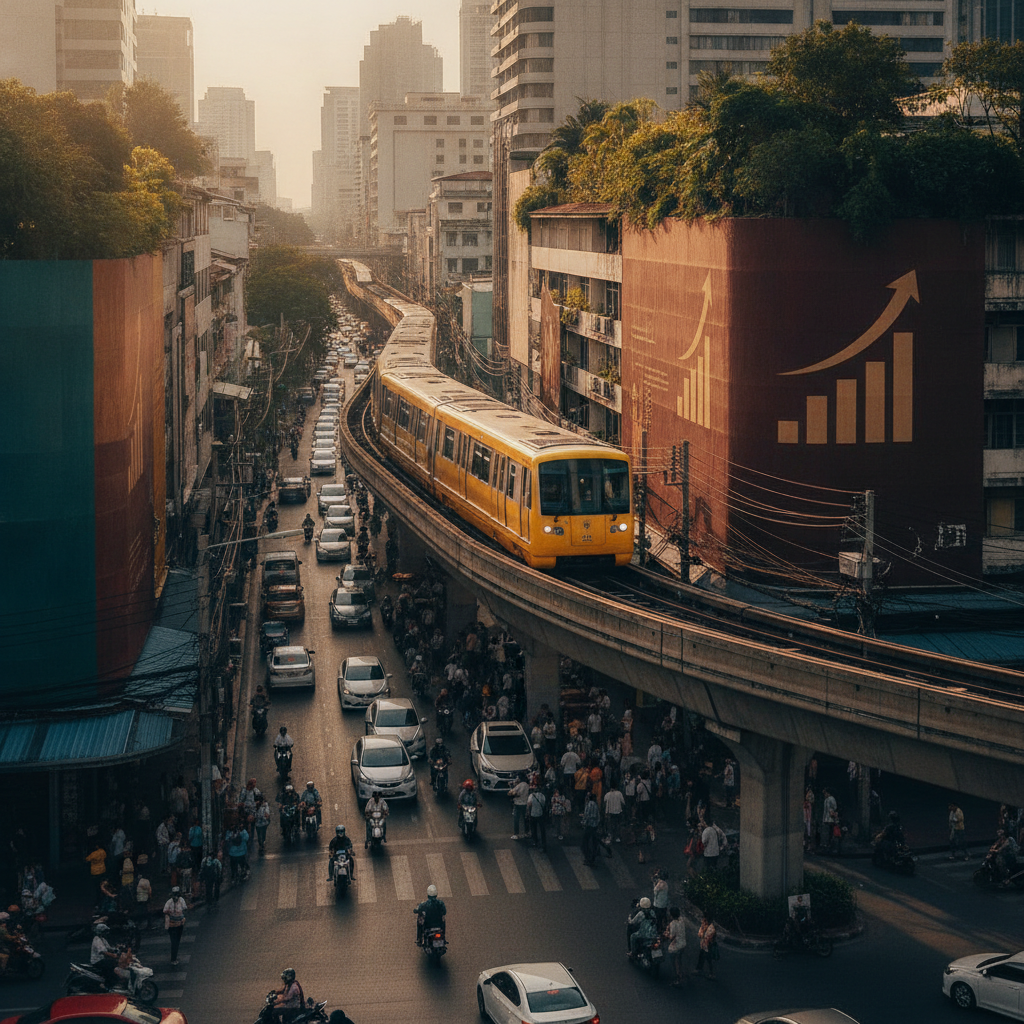
For years, Bangna and Udomsuk sat at the edge of serious investor conversations about Bangkok condominiums — close enough to the CBD to matter, but disconnected enough to discount. That calculus changed the moment the Yellow Line (Lat Phrao–Samrong) reached full operational status and its connecting link to BTS Bearing clicked into place.
The commute equation for residents in these corridors was fundamentally transformed overnight. A professional working in Silom, Asok, or even On Nut now has a credible, air-conditioned, traffic-proof route from Bangna or Udomsuk — and that commuter confidence is being priced directly into rental demand.
Gross rental yields in Bangna and Udomsuk are now tracking in the 4.5–5.5% range, a figure that meaningfully outperforms the broader Bangkok average and sits competitively alongside established performers like On Nut–Punnawithi, which itself pushes past 5% on the right asset.
Insider insight: The Yellow Line's connection to BTS Bearing is the sleeper catalyst most agents aren't talking about loudly enough. It stitches Bangna and Udomsuk into the Sukhumvit BTS trunk line — meaning tenants get direct BTS access without a transfer penalty. That single infrastructure fact is why occupancy on quality condos here is climbing, not just inquiries.
The Yellow Line Bangkok Rental Yield Data: What the Numbers Actually Show
What rental yield can I expect from a condo near the Yellow Line in Bangna or Udomsuk?
Gross rental yields for condominiums near the Yellow Line extension in Bangna and Udomsuk currently range from 4.5% to 5.5% per year, driven by improved transit connectivity and rising tenant demand from both expats and local professionals seeking quality living outside the immediate city center.
Contrast this with the prime CBD districts of Sukhumvit, Silom, and Sathorn, where gross yields run 4.5–6.5% but entry prices are substantially higher. Bangna and Udomsuk offer a compelling yield-to-entry-price ratio — you are getting near-CBD yield performance without near-CBD acquisition costs.
The broader Bangkok market context matters here too. Overall Bangkok property prices in Q1 2026 declined 0.18% year-on-year, but condominiums bucked that trend with a 1.95% price increase. The Yellow Line corridors are part of that condo outperformance story, not an exception to it.
Average new launch prices across Bangkok have risen to approximately THB 150,420 per square metre, reflecting developers' deliberate pivot toward higher-income buyers. In Bangna and Udomsuk, where land costs remain lower than Sukhumvit proper, developers can still price competitively while delivering a product that attracts quality tenants — a rare combination in 2026.
For reference, the Rama 9/Ratchada corridor — another transit-boosted district — sees off-plan prices starting from 75,000 THB per sqm with yields of 5–6%. Bangna and Udomsuk occupy a similar infrastructure-driven appreciation thesis, but with the Yellow Line's connection already operational rather than pending.
Living the Corridor: What Tenants and Owner-Occupiers Actually Get
- Transit access without compromise: The Yellow Line's connection to BTS Bearing means residents access the full BTS Sukhumvit trunk line. Mega Bangna, one of Southeast Asia's largest retail destinations, sits within the same corridor — giving tenants a lifestyle anchor that many inner-city condos cannot match.
- Run club culture is embedded here: Bangkok's surging running club scene — Sabai Run Club, SarDine Run Club, and Lumpini Running Club — operates primarily out of Benjakitti and Lumphini Parks. Both parks are accessible via the extended transit network, making Sunday morning runs a practical reality for Bangna and Udomsuk residents, not just an aspiration.
- Night market proximity: The Train Night Market Srinakarin (Thursday–Sunday, 5 PM–1 AM, behind Seacon Square) sits in the eastern corridor and is one of Bangkok's premier vintage and street food destinations. For tenants who prioritise lifestyle variety, this is a meaningful differentiator versus a Silom condo that offers none of it.
- Jodd Fairs Ratchada access: The newly relocated Jodd Fairs on Ratchadapisek Road near MRT Thailand Cultural Center — with over 1,500 stalls of street food, vintage fashion, and live music — is now reachable via the Yellow Line and MRT interchange, broadening the evening lifestyle radius for residents dramatically.
- Family corridor credentials: The Srinakarin–Krungthep Kreetha eastern corridor, adjacent to Bangna, is actively attracting international school families and offers larger unit configurations. For investors targeting family tenants, two- and three-bedroom units in Bangna command premium rents from this demographic.
- Upcoming events within reach: Black Coffee Run 2026 (September 13) at King Rama 9 Park and KOP RUN Bangkok 2026 at Rajamangala National Stadium both sit in the eastern Bangkok catchment — reinforcing the active-lifestyle identity of the tenant base that gravitates toward this corridor.
Bangkok's 2026 Investment Landscape: Where Bangna and Udomsuk Sit in the Hierarchy
The Bangkok condo market in 2026 is not a single story — it is a tale of diverging trajectories. Weak purchasing power, high household debt, and cautious bank lending are suppressing mid-market demand. But the luxury and transit-adjacent segments are writing a different chapter entirely.
The on-the-ground dynamic in Bangna and Udomsuk mirrors what analysts describe as a 'yield sleeper that woke up' — a corridor where infrastructure investment has converted latent demand into actual signed tenancy agreements. Occupancy on quality condos in prime central Bangkok districts already exceeds 90%. Bangna and Udomsuk are chasing that benchmark, and the Yellow Line is the engine driving the chase.
For foreign buyers specifically, the condominium structure is the only path to full freehold ownership in Thailand — and the 49% foreign quota in any single project means that well-positioned Bangna and Udomsuk buildings with available foreign quota slots represent genuine scarcity value. Since January 2026, the Department of Business Development has also tightened source-of-funds requirements for nominee structures, making the direct condominium freehold route not just legally cleaner, but strategically smarter.
Compare the corridors side by side: Talat Phlu and Wutthakat deliver 5–6% gross yields on the BTS Silom Line, but the tenant base is predominantly Thai. On Nut to Punnawithi reliably pushes past 5% with mixed expat and local demand. Bangna and Udomsuk now sit at 4.5–5.5% with a tenant base that is actively broadening — expats, Mega Bangna-area professionals, and eastern corridor families. The diversification of that demand base is what makes the yield story durable rather than cyclical.
New condominium launches across Bangkok in H1 2026 increased 42% compared to H1 2025 — but this supply surge is concentrated in specific corridors. Investors in Bangna and Udomsuk benefit from a launch pipeline that is more measured than the Sukhumvit mid-market, reducing oversupply risk on the assets most likely to attract quality long-term tenants.
Request Your Bangna and Udomsuk Floor-Plan Analysis
The yield case for Bangna and Udomsuk is no longer theoretical — it is being confirmed in signed tenancy agreements and occupancy rates right now. But not every building in this corridor is equal. Unit orientation, floor level, proximity to the BTS/Yellow Line interchange, and the developer's track record on property management all determine whether you land at the top or the bottom of that 4.5–5.5% yield range.
If you are evaluating a specific project, a floor-plan-level analysis of yield potential, foreign quota availability, and comparable rental evidence is the right first step — not a generic market overview.
Arrange a private floor-plan consultation or request a comparative yield analysis for a specific Bangna or Udomsuk building today. Our team works exclusively with serious buyers and investors, and every briefing is tailored to your target return, tenure horizon, and ownership structure — whether you are a Thai national taking advantage of the current transfer fee environment or a foreign buyer navigating the 2026 freehold quota landscape.
Reach out directly to schedule your session. No pressure. No generic pitch decks. Just specific numbers on specific units.