Investing in Bangkok Property 2026: Navigating Foreign Ownership Rules and Emerging Neighborhoods for Capital Growth

Why 2026 Is a Structural Inflection Point for Bangkok Property Investment
Foreign investors searching for Bangkok property in 2026 are not navigating a routine market cycle. They are entering a landscape fundamentally altered by DBD Order No. 2/2025, which took effect January 1, 2026, and recalibrated the compliance architecture around nominee shareholding structures that previously shielded foreign-held Thai limited companies owning land.
The order tightens scrutiny on Thai shareholders in property-holding companies where foreign nationals hold economic interest disproportionate to their legal equity stake. For buyers operating under legacy nominee arrangements, this is not a nuanced grey area — it is a material legal liability requiring immediate structural review.
What this creates, counterintuitively, is a demand concentration effect. Compliant ownership vehicles — the condominium freehold unit, the BOI-approved long-term lease structure, and the Thai spouse co-ownership framework — are absorbing capital that previously dispersed across less regulated structures. Compliant inventory becomes scarcer. Compliant inventory in transit-anchored, amenity-dense locations becomes scarcer still.
Insider Insight: Bangkok's condominium freehold quota — capped at 49% of total floor area per project for foreign ownership — is now being absorbed faster in sub-markets below the Sukhumvit–Silom axis than at any point since the 2012–2015 Japanese investor wave. Projects in emerging neighborhoods where foreign quota remains open above 30% represent a closing arbitrage window, not a sign of weak demand.
The neighborhood context reshaping investment calculus in 2026 is not confined to the Sukhumvit corridor that dominated the previous decade. Three distinct micro-markets — Rama 9 / Makkasan, Samyan–Silom South, and the Bang Sue Grand Station precinct — are each at different stages of a capital appreciation curve driven by hard infrastructure, not speculation.
Understanding which stage each neighborhood occupies, and matching that to the correct ownership structure for your nationality and tax residency, is the complete investment thesis for Bangkok property in 2026.
Decoding the True Value: Ownership Structures That Actually Protect Foreign Capital in Bangkok
The single most expensive mistake foreign buyers make in Bangkok is conflating legal possession with legally protected ownership. These are not the same thing, and DBD Order No. 2/2025 has made the distinction financially catastrophic for those who ignore it.
What Ownership Routes Are Genuinely Available to Foreign Nationals in 2026?
Condominium Freehold (Condominium Act B.E. 2522): The only route that grants a foreign national direct, titled, transferable ownership of a Bangkok property unit without a Thai intermediary. The title document is a chanote-backed unit title deed (nor sor 4 jor). Foreign remittance evidence via a Foreign Exchange Transaction Form (FET form / Thor Tor 3) is mandatory for units priced above a de minimis threshold. This is non-negotiable, non-retroactable, and the single cleanest capital repatriation structure available.
Long-Term Leasehold (30+30+30): Legally, only the initial 30-year term is enforceable as a registered right at the Land Department. The additional 30+30 extension clauses exist in the private contract between lessor and lessee — they are not automatically registrable and their enforceability in contested inheritance or forced sale scenarios is not absolute. Premium leasehold projects from institutional developers with strong covenant strength represent a credible secondary option, particularly for villa and low-rise product where freehold is structurally unavailable to foreigners.
BOI Investment Visa + Land Ownership: The Board of Investment's RA (Residential Area) scheme allows qualifying foreign investors committing THB 40 million or more into approved asset classes (including condominium units, government bonds, or approved funds) to hold up to 1 rai (1,600 sqm) of land for personal residence. The 2024–2025 BOI amendments have increased the asset class flexibility, but the scheme remains volume-limited and geographically restricted to designated residential zones.
Thai Company Ownership — Post DBD Order No. 2/2025: Any foreign investor currently holding Bangkok property through a Thai limited company should conduct an immediate shareholder structure audit. The order specifically targets companies where Thai shareholders lack genuine economic participation and where board resolutions or shareholder agreements grant the foreign national effective control disproportionate to their equity stake. The risk is not merely administrative — it includes potential voiding of the land title transfer and personal liability for the Thai nominee shareholders.
The 49% Foreign Quota: Where It Stands in Key Bangkok Projects in 2026
Legally, a Bangkok condominium project may not issue freehold title to foreign nationals for more than 49% of its total registered floor area. This is a project-level cap, not a unit-level cap. In practice, the foreign quota in prime Sukhumvit projects (BTS Phrom Phong, BTS Thong Lo, BTS Ekkamai) reached saturation between 2019 and 2023, driven by Hong Kong and Mainland Chinese capital outflows.
The emerging neighborhoods — particularly Rama 9 (MRT Phra Ram 9 / MRT Makkasan Airport Rail Link interchange), Charoen Nakhon (BTS Gold Line), and the Bang Sue Grand Station precinct (MRT Blue Line / Red Line interchange) — retain open foreign quota in the 35–45% range across multiple active projects as of Q1 2026. This is not a signal of weak project quality. It reflects later-cycle development timing, and it closes as infrastructure matures.
Data Point to Anchor Your Valuation: Condominium projects within a 400-metre walk of a Bangkok MRT/BTS interchange station have historically demonstrated 18–24% higher per-sqm resale premiums versus equivalent-specification projects 800+ metres from the same station, measured over a 7-year hold period (2015–2022 CBRE Bangkok Research). In 2026, the Makkasan interchange — connecting MRT Blue Line and the Airport Rail Link — represents the last major Bangkok interchange node where land prices have not yet fully priced in that transit premium.
Can Foreigners Own Property Outright in Bangkok in 2026?
Can foreigners own property outright in Bangkok?
Yes. Foreign nationals can own Bangkok condominium units outright via freehold title under the Condominium Act, provided the project's foreign ownership quota (49% of total floor area) has not been exhausted and purchase funds are remitted from overseas in foreign currency with a valid FET form (Thor Tor 3) as documentation. Land freehold ownership by foreign individuals remains prohibited outside the BOI qualifying investment scheme. Leasehold and company structures carry compliance risks sharpened by DBD Order No. 2/2025, effective January 2026.
This distinction — condominium freehold yes, land freehold no (with narrow BOI exceptions) — is the foundational legal fact every foreign investor in Bangkok must internalize before any other due diligence step. Agents who blur this line, or who present nominee company structures as routine practice post-January 2026, are exposing their clients to regulatory and financial liability that did not exist at the same severity in prior years.
The practical implication for 2026 investment strategy: buyers seeking Bangkok property for capital growth with clean repatriation rights should prioritize condominium freehold units in projects with remaining foreign quota, within 400 metres of MRT or BTS interchange stations, in sub-markets where land price per sqm has not yet closed the gap to comparable Sukhumvit assets. That gap, in neighborhoods like Rama 9 and Bang Sue, currently ranges between 25% and 40% on a per-sqm basis — and it narrows as each infrastructure phase completes.
Seamless Living: Transit Infrastructure Driving the Emerging Neighborhood Investment Case
Bangkok's mass transit network in 2026 is not an amenity. It is the primary determinant of residential asset value, rental yield stability, and resale liquidity. The city's combined BTS Skytrain, MRT Blue and Yellow Lines, MRT Pink Line, and Airport Rail Link now cover 232 kilometres of operational track — a network that did not exist at its current scale as recently as 2019.
The neighborhoods generating the strongest risk-adjusted returns for foreign investors entering in 2026 are those where transit infrastructure has been completed and operational for 12–36 months, but where secondary retail, F&B, and lifestyle infrastructure has not yet fully matured. This is the compression window — when yields are still elevated because rents have not yet caught up to capital values, and when capital values themselves have not yet closed the gap to fully mature comparable locations.
- Rama 9 / Makkasan (MRT Blue Line + Airport Rail Link Interchange): The CBD2 designation by Bangkok Metropolitan Administration formalised in 2023 is translating into Grade A office supply absorption at rates not seen outside the Sukhumvit–Silom core since 2007. Residential rental demand from corporate relocations to Rama 9 towers (G Tower, AIA Capital Center, The PARQ) creates a tenant pool with income profiles comparable to Sukhumvit mid-corridor — at rental rates still 15–20% below Phrom Phong equivalents. Gross rental yields of 5.2–6.1% are currently achievable on well-positioned sub-60sqm units.
- Charoen Nakhon / Khlong San (BTS Gold Line + Riverside Express Boat): The ICONSIAM effect on surrounding land values was initially dismissed as retail-driven and therefore transient. Five years post-opening, the data contradicts that dismissal. Condominium resale premiums within 600 metres of ICONSIAM have compounded at 7.2% annually since 2019 (Agency for Real Estate Affairs data). The BTS Gold Line extension currently under planning to connect Krung Thonburi with expanded Thonburi coverage will deepen this dynamic further.
- Bang Sue Grand Station Precinct (MRT Blue Line + Red Line + Future High-Speed Rail Hub): This is the longest-horizon play and the highest-risk, highest-potential-upside node in Bangkok's 2026 investment landscape. Bang Sue Grand Station is designed to be Southeast Asia's largest rail terminus — connecting high-speed rail to Chiang Mai, Nakhon Ratchasima, and potentially Hat Yai with the existing metropolitan network. Land within 800 metres of the station entrance is currently priced at THB 280,000–350,000 per sqm — compared to THB 600,000–900,000 per sqm at Asok interchange. The infrastructure is built. The value gap is a timing gap, not a quality gap.
- Samyan–Silom South (MRT Sam Yan + MRT Si Lom): The 2024 opening of Samyan Mitrtown Phase 2 and the Michelin Bib Gourmand density in the Charoen Krung–Silom South corridor have repositioned this neighborhood for a younger, internationally mobile professional tenant profile. Studio and one-bedroom units in this corridor are achieving occupancy rates above 91% on annual lease terms — the highest in Bangkok outside of Phrom Phong and Thong Lo.
Transit proximity alone does not generate returns. The investment thesis requires transit proximity combined with open foreign quota, correct ownership structure, and a project developer with demonstrated track record of delivering title deeds on schedule. All four variables must be present simultaneously.
Bangkok Property Investment Returns in 2026: Rental Yields, Capital Growth Projections, and the Layouts That Actually Lease
The single most persistent myth in Bangkok property investment is that all condominium layouts perform equally. They do not. The tenant demographic driving occupancy in Bangkok's emerging neighborhoods has specific, non-negotiable spatial requirements that directly determine whether a unit achieves sub-30-day vacancy or sits dark for 60–90 days between leases.
What Unit Configurations Generate the Strongest Rental Yields in Bangkok in 2026?
Studio units (22–30 sqm) with efficient kitchen separation and dedicated workstation alcove: The post-pandemic work-from-Bangkok model has permanently elevated the minimum functional space requirement for professional tenants. Studios below 25 sqm with open-plan kitchen are structurally disadvantaged versus same-size units where a kitchen partition — even a partial one — creates a psychological separation between living and working zones. Yields on well-configured studios in transit-proximate emerging neighborhoods: 5.5–6.8% gross.
One-bedroom units (35–50 sqm) targeting the dual-income expat couple profile: This is the highest-demand, lowest-vacancy segment across all Bangkok emerging neighborhoods in 2026. The profile: one or both occupants employed by multinational firms in the Rama 9 CBD2 cluster or Asok–Ratchathewi corridor, household income above THB 120,000/month, lease term preference of 12–24 months, and strong preference for in-building facilities (co-working space, lap pool, fitness centre with free weights, not just cardio machines). Gross yields: 4.8–5.6%. Capital growth projection (5-year hold): 18–28% in Rama 9 sub-market based on CBD2 office absorption trajectory.
Two-bedroom units (65–85 sqm) targeting family expat or Japan-market investor profiles: Japanese investors have historically favoured two-bedroom Bangkok condominiums for the rental yield differential between Bangkok and Tokyo residential yields. With JR East and major Japanese logistics firms expanding Thai operations through 2026–2028, Japanese tenant demand in Sukhumvit sub-25 and Rama 9 remains structurally supported. Two-bedroom gross yields: 4.2–4.9%. Lower yield, but materially lower vacancy risk and longer average lease terms (18–36 months).
Capital Growth: What the Data Actually Shows for Emerging Bangkok Sub-Markets
CBRE, Colliers, and Jones Lang LaSalle Bangkok research consistently identifies the same pattern in Bangkok sub-market appreciation cycles: a 3–5 year lag between major transit infrastructure completion and full land value capitalisation into residential unit prices. The Phrom Phong BTS station opened in 1999. Condominium per-sqm values in that micro-market did not reach their current THB 180,000–220,000/sqm range until the mid-2010s.
Makkasan MRT / Airport Rail Link interchange has been operational since 2010. The Rama 9 CBD2 designation arrived in 2023. Per-sqm condominium values in Rama 9 as of Q1 2026 range from THB 115,000–155,000/sqm for new launches. The trajectory implied by comparable sub-market maturation cycles suggests a 10–15 year appreciation runway to close the gap with Asok and Phrom Phong — even under conservative assumptions about Bangkok's broader economic growth.
For investors with a 5–7 year hold horizon, the emerging neighborhood thesis is not speculative. It is a documented pattern playing out on a different section of the same infrastructure-driven appreciation curve that already produced returns in the locations those same investors now consider too expensive to enter.
The Compression Trade in Plain Language: Buying a correctly structured, transit-proximate Bangkok condominium in an emerging neighborhood in 2026 is not a bet on Bangkok's future growth. It is a bet that Rama 9 will, over the next decade, be priced like Asok — two MRT stations apart, same Blue Line, same commute time to Siam. That is not a speculative thesis. That is a mean-reversion trade with hard infrastructure as its catalyst.
Tax and Repatriation Considerations for Foreign Investors in 2026
Thailand's Revenue Code Amendment effective January 1, 2024, extended the personal income tax obligation on foreign-sourced income remitted to Thailand — regardless of the tax year in which it was earned — to Thai tax residents (those spending 180+ days per year in Thailand). For foreign property investors who are not Thai tax residents and who maintain non-resident status, the direct impact is limited to Thai withholding tax on rental income (15% for corporate recipients, progressive rate for individual recipients) and specific business tax (SBT) of 3.3% on gross sale proceeds for properties held under 5 years.
For investors structuring Bangkok property within a self-managed Thai company for rental income management: post-DBD Order No. 2/2025, the corporate structure must reflect genuine operational substance. Shell companies with nominee directors and no active property management operations now attract elevated scrutiny. The compliant path is a company with genuine Thai directors, documented operational activity, and shareholding reflecting actual economic participation — not a structure designed to circumvent foreign ownership restrictions on land.
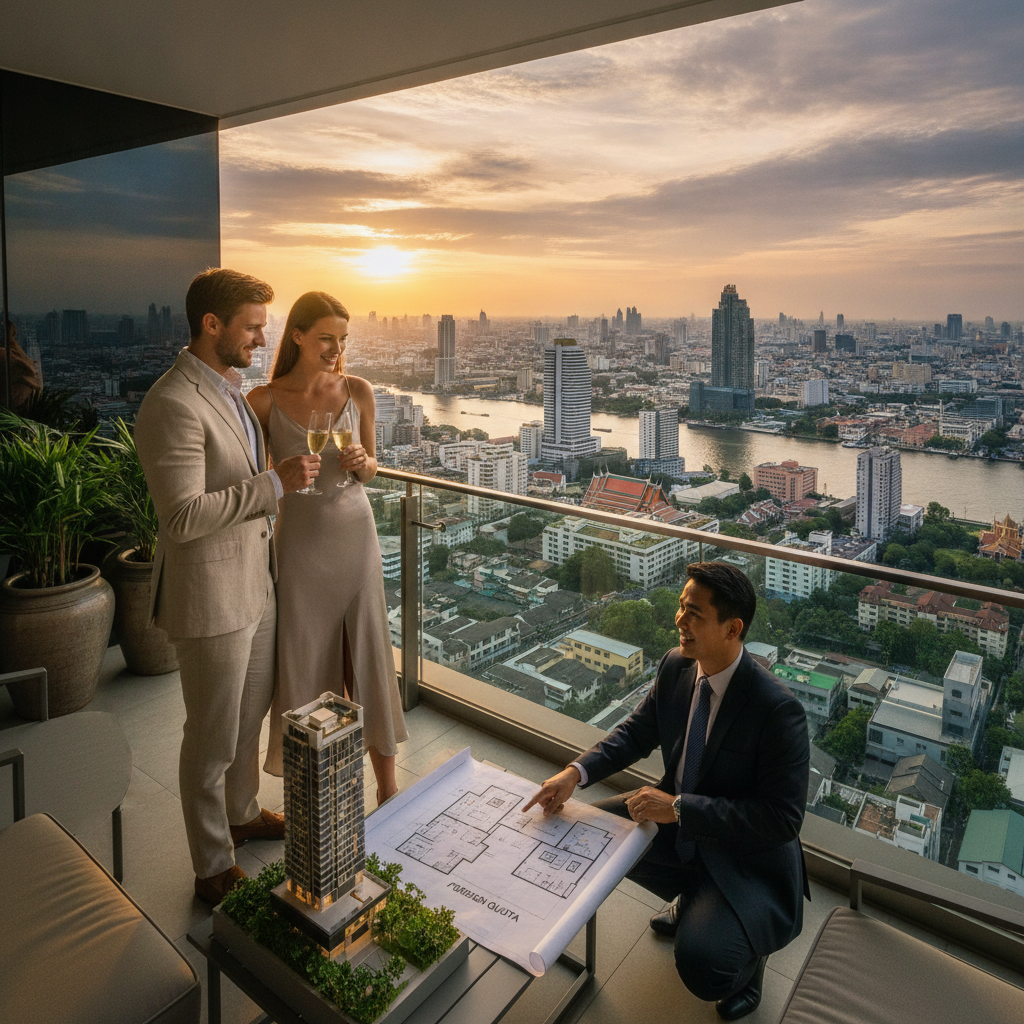
Request a Private Floor-Plan Analysis or Viewing Arrangement for Available Bangkok Residences
The Bangkok properties generating the strongest 2026 investment case — freehold title, open foreign quota, transit interchange proximity, emerging neighborhood compression trade, correct legal structure — are not properties you find by browsing a portal at 2am. They are properties identified through sub-market expertise, developer relationship access, and the legal due diligence workflow that ensures the unit you are viewing is the unit you will actually receive clear title on.
If you are a foreign national evaluating Bangkok property investment in 2026, the first conversation is not about which unit to buy. It is about whether your current ownership structure, or your intended structure, is legally sound under DBD Order No. 2/2025. That conversation is free, and it is the only responsible starting point.
The second conversation is about matching your capital allocation, hold period, and yield or appreciation objectives to the specific sub-market, project quality tier, and unit configuration that genuinely fits those parameters — not the inventory that happens to be available at commission this week.
- Private floor-plan analysis: We will map available units with open foreign quota in Rama 9, Charoen Nakhon, Bang Sue, and Samyan against your investment parameters and provide a structured comparative analysis within 48 hours.
- Private viewing arrangement: Developer-direct access to show units — including pre-launch inventory not yet publicly listed — in emerging neighborhood projects where foreign quota remains open.
- Ownership structure audit: Pre-purchase legal pathway review confirming the cleanest compliant structure for your nationality, tax residency, and repatriation requirements under 2026 regulations.
- Rental yield validation: Sub-market rental comparables, actual (not projected) vacancy data, and tenant profile analysis for the specific unit configuration and building you are evaluating.
Bangkok property investment in 2026 rewards preparation and penalises assumption. The window for entering emerging neighborhoods at pre-compression pricing, with open foreign quota and compliant ownership structure, is measurable in months — not years.
Contact us directly to arrange a private consultation, floor-plan analysis, or viewing. No obligation. Full confidentiality. Conversations led by specialists, not sales agents.