Bangkok Real Estate 2026: How to Own Smart, Stay Liquid, and Avoid Getting Frozen Out

The 2026 Bangkok Property Freeze: What the Numbers Actually Mean for Your Portfolio
Bangkok is not experiencing a general property crisis — it is experiencing a deeply uneven market correction where 350,000 unsold residential units are concentrated in specific price bands, specific districts, and specific building typologies. The investors who panic will sell at a loss. The investors who understand the data will buy the distressed stock that the panicking sellers are liquidating.
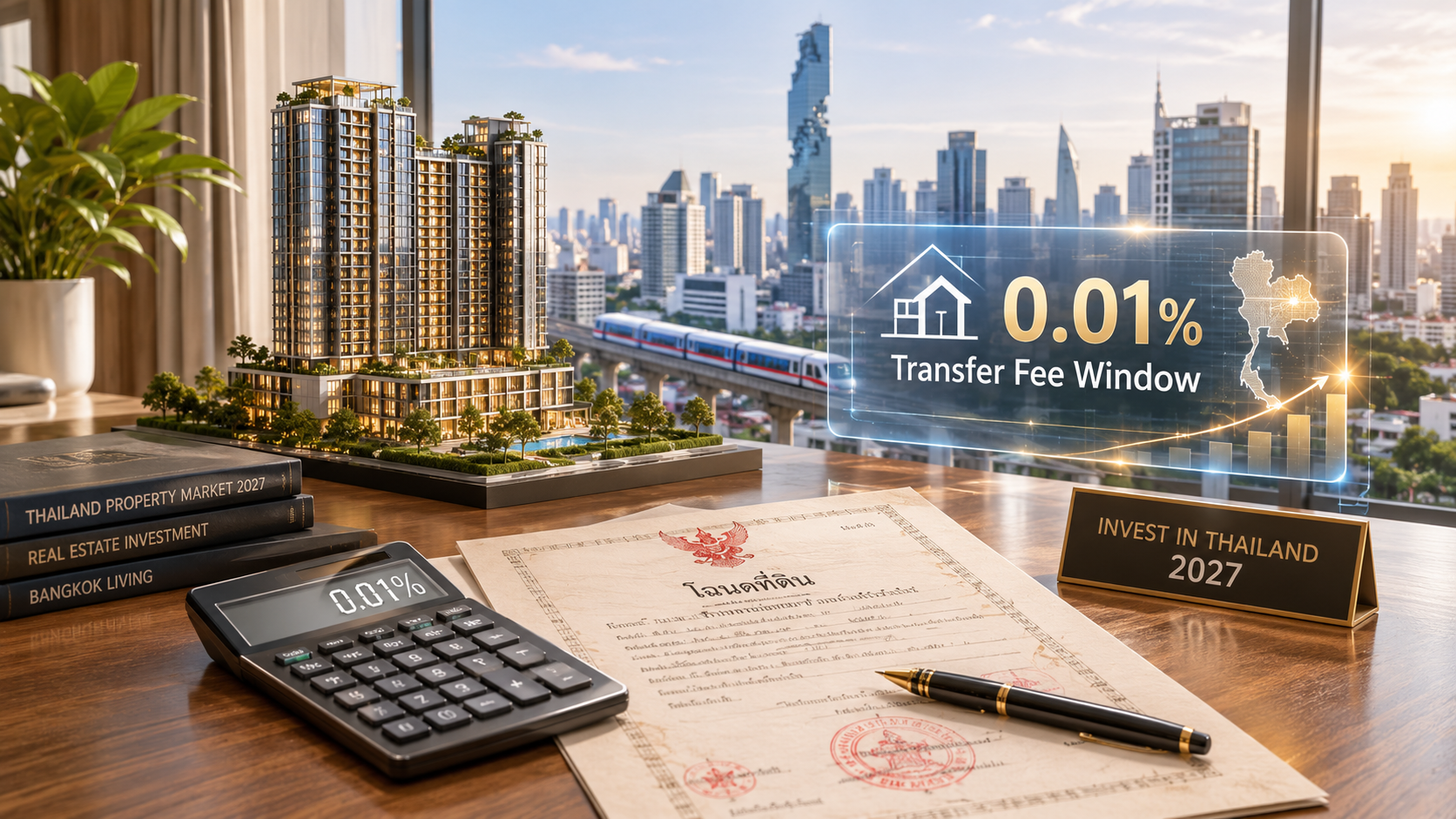
The 2026 tax law revisions alter the holding cost equation for every residential asset in the country. Land and building tax obligations, transfer fees, and the revised personal income tax treatment of rental yields are not abstract policy changes — they are direct hits to your monthly cash flow and your exit-multiple calculation if you own the wrong product in the wrong location.
Understanding precisely which combinations of district, building age, unit size, and tenure structure are insulated from this pressure — versus which are exposed — is the single most valuable piece of intelligence any Bangkok property participant can possess right now.
Insider Insight: The 350,000-unit overhang is overwhelmingly concentrated in the THB 1.5M–3M mass-market condo segment in outer fringe districts beyond the 30-kilometre BTS/MRT radius. Prime inner-city freehold product under 60 sqm with genuine transit walkability is operating in an effectively separate supply-and-demand environment — one where new completions remain structurally constrained by land cost and density regulation.
Decoding the True Value of Bangkok Residential Assets in a Correction Cycle
The word 'oversupply' appearing in headlines does not mean every Bangkok postcode is oversupplied. It means the aggregate national figure looks alarming when you combine Chiang Rai studio inventory with Sukhumvit penthouse stock and report a single number. Serious buyers and serious sellers know this distinction. Casual market participants do not — and that gap is where opportunity lives.
Three hyper-local data points currently separate the assets that will hold value from those that will not:
- Walking distance to a named BTS or MRT station under 400 metres: Rental vacancy rates for units genuinely within 400 metres of a working station run approximately 40% lower than comparable units at 800 metres. In a market where rental yields are under tax-revision pressure, occupancy rate is the primary lever you still control.
- Freehold versus leasehold tenure on the specific title document: Leasehold product is facing accelerated secondary market discounting as foreign buyer pools — particularly post-2025 regulatory scrutiny of nominee company structures — shift demand firmly toward Chanote freehold titles. The delta between freehold and leasehold pricing for comparable units in the same building is widening, not narrowing.
- Building completion year relative to EIA-compliant construction standards: Buildings completed after 2017 carry materially lower latent structural liability and meet current fire and electrical compliance benchmarks. This matters for insurance costs, for juristic person reserve fund adequacy, and for the risk profile of any institutional buyer who may represent your eventual exit counterparty.
Applying these three filters to the Bangkok listing inventory as it stands today eliminates the majority of the 350,000-unit overhang from your consideration set immediately. What remains is a far smaller, far more defensible universe of assets.
What Are the New Property Tax Rules in Bangkok for 2026 and How Do They Affect Foreign Buyers?
What Are the New Property Tax Rules in Bangkok for 2026 and How Do They Affect Foreign Buyers?
Bangkok's 2026 land and building tax revisions end the temporary rate reductions in place since COVID-19. Foreign-owned freehold condominiums used as primary residences face a 0.02% annual rate; investment or rental units face up to 0.3%, directly reducing net rental yields by an estimated 0.1–0.25 percentage points depending on declared asset value.
The distinction between 'owner-occupied' and 'investment' classification is now enforced through the tabien baan (household registration) record rather than through self-declaration alone. Foreign nationals who cannot register on a blue tabien baan — which the majority cannot — are automatically assessed at the higher investment rate regardless of their actual occupancy pattern.
This creates a structurally lower net yield floor for foreign-held residential units compared to Thai-national holders of identical assets. Buyers entering the market now must underwrite this differential into their yield models from day one rather than treat it as a future variable.
The practical implication: gross yield requirements for foreign buyers purchasing Bangkok investment condominiums need to clear approximately 5.5–6.5% to deliver a net-of-tax return competitive with alternative asset classes — a threshold achievable in the inner-city short-term rental corridor but challenging in the mass-market suburban segment where the bulk of the overhang sits.
Seamless Living and Liquidity: Why Transit Proximity Is the One Variable You Cannot Retrofit
You can renovate a kitchen. You can upgrade a sound system. You can repaint a lobby. You cannot move a building closer to a BTS station after you have bought it. Transit proximity is the only value driver in Bangkok residential property that is genuinely permanent and genuinely irreplaceable — which is precisely why it commands a price premium that has expanded, not contracted, through every market cycle of the past fifteen years.
Current access infrastructure that defines the upper tier of Bangkok residential desirability includes:
- BTS Sukhumvit Line: Asok, Phrom Phong, and Thong Lo interchange nodes remain the three most liquid residential postcodes for resale in the entire Bangkok metropolitan area. Average days-on-market for freehold units within 350 metres of these stations consistently runs below the city-wide median by 60–90 days.
- MRT Blue Line extensions: The completed Bang Sue Grand Station interchange and the ongoing western extension toward Bang Kae are repricing previously undervalued mid-city locations. Buyers who moved twelve months before these corridors reached full operational capacity captured the most significant appreciation cycles in recent Bangkok history.
- Expressway and tollway access for non-rail commuters: The Si Rat Expressway and Chalerm Maha Nakhon Expressway network continues to underpin the value of villa and landed product in Sathorn, Bang Na, and the inner Rama 9 corridor for residents whose professional or lifestyle patterns are car-dependent rather than rail-dependent.
- Airport link proximity for internationally mobile residents: Inner Sukhumvit addresses within two BTS stops of the Phaya Thai Airport Rail Link interchange maintain a rental premium specifically attributable to the expat and frequent-flyer tenant pool — a demographic whose rental budget is both higher and more stable than the median Bangkok tenant.
When the 2026 tax environment compresses yields across the board, the assets that hold their gross rental rate — because tenant demand for their specific location remains inelastic — are the ones that survive the compression with acceptable net returns intact.
Bangkok Condo Investment Strategy 2026: The Layouts, Yields, and Ownership Structures That Still Work
The nominee company crackdown — the most significant structural shift in Bangkok foreign property participation in over a decade — is not a marginal regulatory adjustment. It is a fundamental repricing of risk for any foreign national currently holding Thai residential or landed property through a Thai Limited Company structure with a majority of nominee Thai shareholders.
The legal exposure runs in three directions simultaneously: criminal liability under the Land Code for the foreign beneficial owner, personal liability for the Thai nominee directors who signed the company documents, and asset seizure risk that removes the property from the market entirely pending resolution — which is precisely the 'frozen asset' scenario that gives this moment its urgency.
The structures that remain legally sound for foreign residential property participation in Thailand as of 2026 are a short and specific list:
- Condominium freehold under the Condominium Act (Foreign Quota): Up to 49% of total registered floor area in any given condominium building can be freehold-titled to foreign nationals. This is the cleanest, most liquid, and most legally durable ownership structure available. It is also the one most directly impacted by the 2026 tax revisions at the investment rate — a cost that should be modelled in but does not eliminate the structure's fundamental soundness.
- 30-year leasehold with two optional renewal periods registered on title: Legally permitted, widely used for landed and villa product where the freehold quota route is unavailable. The secondary market discount versus freehold is real and is widening — buyers entering this structure must have a clear and realistic exit thesis, not a vague assumption that a future buyer will accept the same discount they are now paying.
- Thai spouse or majority-Thai-national company with genuine operational substance: Where the Thai shareholding reflects actual economic participation rather than nominee arrangement, and where the company has operating business activity that justifies property ownership, the structure remains legally defensible. This requires proper legal architecture, not a template company formed by a property developer's in-house legal team on the day of signing.
On the question of layout and unit sizing: the Bangkok rental market in 2026 is bifurcating sharply between studio and one-bedroom units under 40 sqm targeting the single-professional and short-stay tenant market (where yields remain highest but regulatory risk around short-term rental classification is increasing) and two- and three-bedroom units of 70–120 sqm targeting the family expat and long-stay professional market (where yields are lower but tenant quality, lease duration, and asset preservation are materially superior).
The mass-market investor reflex toward the smallest possible unit to maximise per-sqm yield is precisely the strategy most exposed to the 2026 headwinds. The counter-intuitive move — larger units, longer leases, more selective tenant qualification — is producing more durable income streams in the current environment.
Schedule a Private Consultation on Bangkok Property Strategy and Available Residences
If the 2026 tax revisions, the nominee company enforcement environment, or the 350,000-unit overhang has created uncertainty in your current Bangkok property position — or if you are approaching the market as a buyer and want to identify precisely which assets clear the transit, tenure, and yield filters outlined in this analysis — the right next step is a direct, confidential conversation.
We do not offer generic listing tours. We offer structured floor-plan analysis sessions that map your specific financial parameters, your legal ownership structure constraints, and your target yield or appreciation objective against the real-time inventory of inner-Bangkok assets that meet the criteria described above.
The conversation takes thirty minutes. The intelligence it produces is directly actionable. There is no obligation attached to the session — only the clarity that comes from working through the numbers with someone who has run them on this market specifically, not on a regional model that treats Bangkok as interchangeable with any other Southeast Asian gateway city.
- Request a private floor-plan analysis for a specific building or postcode currently on your shortlist.
- Request a yield stress-test of an asset you currently hold against the 2026 tax rate revisions.
- Request a legal structure review if you currently hold Bangkok property through a company structure and have not had it assessed against the current nominee enforcement criteria.
Use the contact form below to specify which of the three you need, include your timeline and budget parameters, and a consultant will respond within four business hours with a proposed session time. Private viewing arrangements for specific available residences can be confirmed at the same time for those at the active acquisition stage.