Buying a Condo for Long-Stay Living in Bangkok: The Definitive 2026 Guide for Foreign Residents
Why January 2026 Changed Everything for Foreign Long-Stay Buyers in Bangkok
Foreign nationals searching for a permanent base in Bangkok are no longer navigating the same market that existed twelve months ago. The Department of Business Development's January 2026 directive, combined with a sustained reduction in property transfer fees capped at 1%, has compressed the total acquisition cost for qualified foreign buyers by a margin that makes renting — even long-term renting — financially indefensible for those intending a stay of three years or more.
This is not a speculative window. The fee reduction is government-confirmed through the end of the fiscal year, and Bangkok's five core long-stay corridors — Sukhumvit 24–39, Sathorn, Riverside, Ratchada–Lat Phrao, and the Rama 9 CBD node — are seeing signed-contract velocity that has not been recorded since pre-2020. The buyer profile has also shifted: the dominant purchaser is no longer a purely investment-motivated offshore buyer but a working or semi-retired foreign national who intends to live in the unit for a minimum of 180 days per year.
Insider Insight: Bangkok's Condominium Act already permits foreign nationals to hold freehold title on up to 49% of any registered condominium building's total sellable floor area. In practice, the buildings where that foreign quota is approaching saturation — particularly along Sukhumvit between Asok and Thong Lo — are precisely the ones commanding a 12–18% resale premium over comparable quota-available stock. Buyers who wait for quota availability in trophy addresses are often paying more than those who moved during the current transfer-fee suppression window.
The neighborhood context matters acutely here. A long-stay buyer is not optimizing for a weekend pied-à-terre. They are optimizing for walkable infrastructure — international-grade hospitals within two kilometers, BTS or MRT access under 400 meters, English-language administrative services in the immediate vicinity, and a building management team fluent in handling multi-year foreign resident needs: mail forwarding, lease extensions, TM30 filings, and utility registration. Those operational specifics eliminate the majority of Bangkok's condo stock immediately.
Decoding the True Value of Bangkok's Premier Long-Stay Condo Addresses
The price per square meter headline figure is the least reliable number in Bangkok's luxury residential market. A unit listed at THB 180,000/sqm in a building on Sukhumvit Soi 31 with a full-time resident manager, a 49% foreign quota still 15% below saturation, and direct covered walkway access to Phrom Phong BTS is categorically a different asset from a unit priced at THB 165,000/sqm in a building three sois away where the juristic office closes at 6 PM and the foreign quota is exhausted.
The hyper-local data points that actually determine long-stay livability — and therefore resale liquidity — in Bangkok's top residential corridors are as follows:
- Foreign Quota Remaining: Buildings below 35% foreign quota saturation offer the best combination of freehold security and future resale to an international buyer pool. Buildings above 44% saturation begin to restrict your exit options to Thai-national buyers only, which statistically narrows your resale market by approximately 60%.
- Hospital Proximity (Sub-2km): Bumrungrad International (Sukhumvit Soi 3), Samitivej Sukhumvit (Soi 49), Bangkok Hospital (Petchaburi), and BNH (Silom) represent the four anchor points around which long-stay foreign residents self-organize. A condo within 1.5km of any of these facilities commands a demonstrable rental premium of 8–14% among the medical-tourism and long-stay health-conscious segment.
- Building Age and Management Provenance: For long-stay use, buildings completed between 2015–2022 sit in a favorable maintenance sweet spot — modern MEP systems, post-2010 seismic standards, and sinking funds that are not yet depleted. Buildings completed before 2010 require granular due diligence on elevator certification, water pipe condition, and reserve fund adequacy.
- Unit Configuration for Long Residency: The 65–85 sqm two-bedroom format is the dominant long-stay configuration. It accommodates a working-from-home setup, a guest bedroom for visiting family, and sufficient kitchen infrastructure for daily meal preparation — a non-negotiable for residents who are not eating out seven days a week. Sub-50 sqm studios underperform on long-stay retention metrics and show lower annual rental yield stability in this specific use case.
- 2026 Transfer Fee Window: At the current 1% transfer fee (versus the standard 2%), a THB 8,000,000 unit saves the buyer THB 80,000 in government fees alone at closing — approximately equivalent to two months' utility and service charge costs in a premium building. For transactions above THB 15,000,000, the saving is structurally meaningful in any DCF analysis.
Can a Foreigner Own a Condo Freehold in Bangkok for Long-Stay Purposes in 2026?
Featured Answer: Foreign nationals can own Bangkok condominium units freehold under the Thai Condominium Act, provided the building's foreign ownership quota — capped at 49% of total sellable area — is not exhausted. In 2026, the DBD's updated documentation process has streamlined Foreign Exchange Transaction (FET) certificate requirements for purchases funded by overseas remittance.
The practical mechanics in 2026 look like this. A foreign buyer remits funds from an overseas bank account in a foreign currency to a Thai bank account held in their own name. The receiving Thai bank issues a Foreign Exchange Transaction form (formerly Thor Tor 3, now consolidated under the DBD's 2026 FET framework). That FET certificate is the foundational document proving the funds originated outside Thailand — without it, the Land Department will not register freehold title in a foreign name.
For long-stay buyers specifically, there is an additional tax-residency consideration that most online guides omit. If you spend more than 180 days per year in Thailand and receive foreign-source income remitted into Thailand in the same calendar year, you are subject to Thai personal income tax on that remitted income under the Revenue Department's 2024-onwards global income assessment rules. A Bangkok-based tax advisor familiar with expat treaty provisions should be engaged before remitting purchase funds if your income structure involves overseas employment, investment income, or digital business revenue.
The visa architecture that supports long-stay condo ownership in 2026 spans four primary categories relevant to foreign property buyers:
- LTR Visa (Long-Term Resident Visa): Introduced in 2022 and substantially refined by 2025, the LTR visa targets high-net-worth individuals (minimum USD 1M in assets or USD 80,000/year income), remote workers for foreign companies (minimum USD 40,000/year income), and retirees (minimum USD 40,000/year income or USD 250,000 in Thai financial instruments). LTR holders receive a 10-year visa, work permit eligibility, and fast-track Land Department service — the single most powerful visa product for serious long-stay condo buyers.
- Thailand Elite Visa (Privilege Card): The 5-year and 20-year tiers provide renewable 1-year entry permits and are favored by buyers who do not meet LTR income thresholds but want hassle-free immigration compliance without annual 90-day reporting anxiety.
- Non-Immigrant O-A (Retirement Visa): Requires age 50+, THB 800,000 in a Thai bank account or THB 65,000/month income, and annual renewal. Functionally straightforward for retirees already banking in Thailand.
- Non-Immigrant B (Business Visa): Relevant for foreign nationals employed by BOI-promoted companies or operating registered Thai businesses — often the entry point for expats whose employer sponsors their Bangkok relocation.
Seamless Living: Transit Proximity and the Bangkok Neighborhoods That Actually Work for Long-Stay Foreign Residents
Bangkok's mass transit grid is the single most consequential variable in long-stay livability. The city's traffic dynamic means that a condo 600 meters from a BTS station and a condo 600 meters from the nearest arterial road with no rail access represent entirely different quality-of-life propositions — a gap that widens dramatically when you are not occasionally visiting but living daily.
The five long-stay corridors worth granular attention in 2026, mapped against transit access, hospital proximity, and foreign buyer concentration:
- Sukhumvit BTS Corridor (Asok to Thong Lo — BTS Sukhumvit Line): The highest-liquidity corridor for foreign-owned resale stock in Bangkok. Asok interchange (BTS + MRT Sukhumvit) places residents within 22 minutes of Suvarnabhumi Airport via the Airport Rail Link at Phaya Thai (one interchange). Bumrungrad International is a 12-minute metered taxi from Asok. Thong Lo and Ekkamai (BTS) anchor the F&B and co-working ecosystem favored by the under-45 digital professional long-stay cohort. Typical 2BR freehold pricing: THB 7.5M–22M depending on building tier and floor.
- Sathorn–Silom (BTS Silom Line, MRT Lumphini/Silom): The preferred corridor for finance-sector expats, diplomatic community long-stayers, and buyers who prioritize proximity to the Chong Nonsi–Sala Daeng–Lumphini business and diplomatic triangle. BNH Hospital is walkable from multiple Sathorn addresses. The corridor offers slightly more competitive per-sqm pricing than upper Sukhumvit for comparable build quality. Typical 2BR pricing: THB 6.8M–18M.
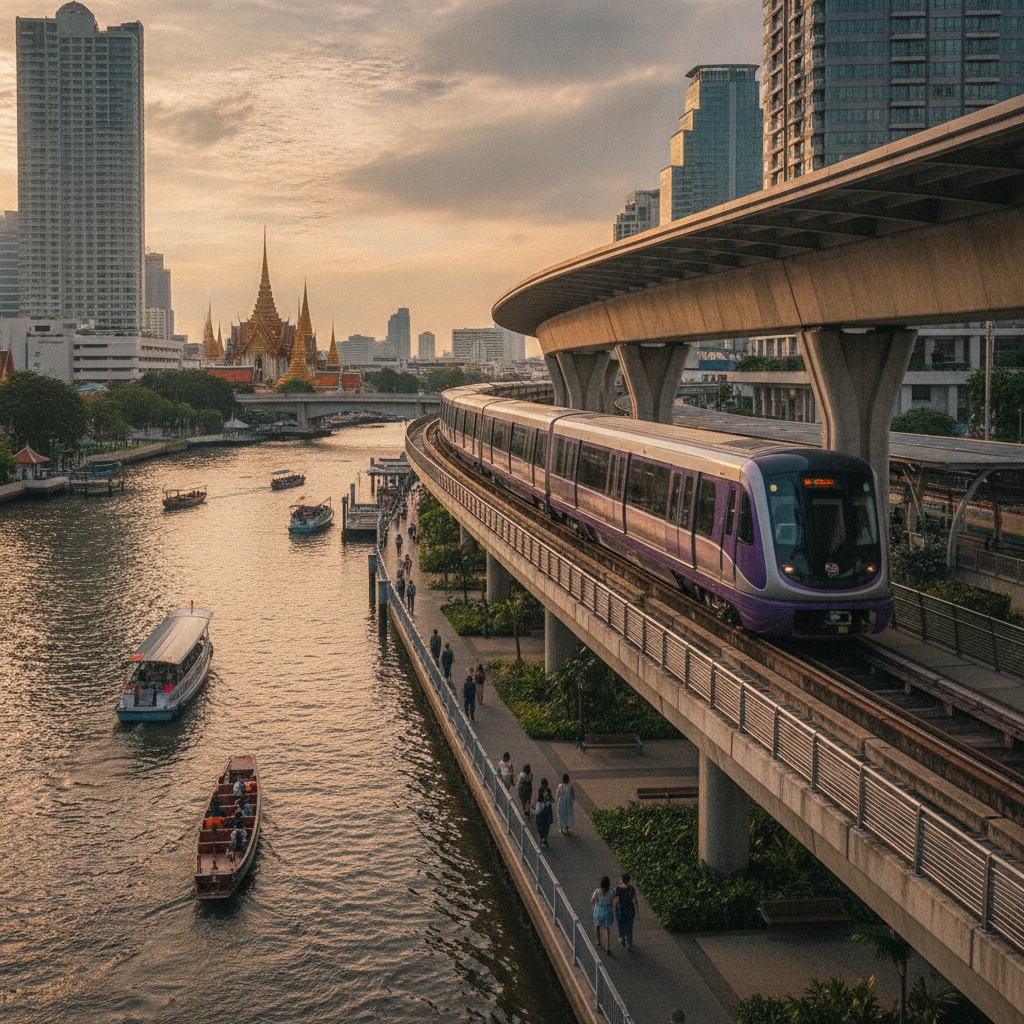
- Riverside (BTS Saphan Taksin, River City pier): Lower transit density than Sukhumvit, but the lifestyle proposition is architecturally distinct — river views, lower ambient noise, and a buyer profile that skews toward semi-retired long-stayers and arts-adjacent professionals. The introduction of the Gold Line BTS extension and improved river bus frequency has meaningfully improved connectivity since 2023. Typical 2BR pricing: THB 9M–28M in trophy riverside addresses.
- Ratchada–Lat Phrao (MRT Blue Line: Thailand Cultural Centre, Lat Phrao): The highest value-per-sqm corridor in Bangkok's long-stay market right now. MRT Blue Line provides direct interchange access to the CBD, Chatuchak, and the airport link via Phaya Thai. Samitivej Ratchada and Vichaiyut Hospital anchor healthcare access. Buildings here are 20–35% cheaper per sqm than equivalent-spec Sukhumvit stock, with a faster-appreciating base driven by infrastructure investment. Strongly favored by Japanese, Korean, and Chinese long-stay buyers familiar with MRT-centric urban living. Typical 2BR pricing: THB 4.2M–9.5M.
- Rama 9–New CBD (MRT Blue Line: Phra Ram 9, Makkasan): The most institutionally active development corridor in Bangkok. AIA Capital Center, G Tower, and the Unilodge–AIA mixed-use precinct have transformed this from a secondary node to a genuine CBD alternative. The 2BR stock here is newest in average age (2017–2024), heavily amenitized, and positioned at a price point that delivers strong rental yield (5.2–6.8% gross) for buyers who want long-stay flexibility with an investor floor under the asset. Typical 2BR pricing: THB 5.5M–13M.
Long-Stay Rental Yields, Ownership Costs, and the 2026 Financial Case for Buying Over Renting in Bangkok
The rent-versus-buy calculation for a foreign long-stay resident in Bangkok in 2026 has shifted decisively toward ownership for anyone with a confirmed 3-year-plus horizon. The arithmetic is direct.
A well-located 70 sqm two-bedroom unit in the Sukhumvit 24–39 corridor rents at approximately THB 45,000–65,000 per month for a modern mid-tier building. Over three years at the midpoint (THB 55,000/month), total rent expenditure is THB 1,980,000 — with zero asset accumulation, zero hedge against Thai baht appreciation of your home currency, and zero participation in Bangkok's residential price trajectory.
The equivalent unit purchased freehold at THB 9,500,000 with a 30% cash downpayment (THB 2,850,000) and a Thai bank mortgage at 5.5% interest over 20 years costs approximately THB 52,000/month in combined principal and interest — roughly equivalent to the rental outgoing — while building equity in a freehold asset denominated in a currency that has demonstrated structural stability against the USD and EUR over 10-year rolling periods.
- Gross Rental Yield (Sukhumvit mid-corridor, 2BR, 65–80 sqm): 4.8–6.2% per annum based on Q4 2025 CBRE and DDProperty transaction data.
- Net Yield after Management, Maintenance, and Common Area Fees: 3.4–4.6% — still competitive against comparable liquid assets available to foreign nationals in most G7 markets at current rates.
- Capital Appreciation (5-year rolling average, Grade A Bangkok condo stock): 2.8–4.1% per annum in THB terms. In USD terms, the 2020–2025 period showed muted appreciation due to baht softness, but the 2025–2026 baht stabilization trend has begun restoring USD-equivalent returns.
- Annual Ownership Costs (typical 70 sqm freehold unit): Common area maintenance fee: THB 35–75/sqm/month (THB 29,400–63,000/year). Property tax (Land and Buildings Tax at 0.02% of appraised value for primary residence): THB 1,900–4,200/year on typical long-stay units. Building insurance: THB 8,000–15,000/year. Total annual holding cost before mortgage: approximately THB 39,000–82,000 — structurally lower than equivalent freehold markets in Singapore, Hong Kong, or Sydney.
- 2026 Transfer Fee Impact: At 1% government transfer fee (versus standard 2%), total closing costs for a THB 10,000,000 purchase run approximately THB 150,000–220,000 all-in (transfer fee, specific business tax or stamp duty, title deed fee). This is the lowest total transaction cost environment Bangkok has offered foreign buyers since 2009.
Market Intelligence Note: Bangkok's Grade A long-stay condo segment is currently experiencing its tightest foreign-quota availability since 2018 in the Sukhumvit 24–33 micro-market. Buildings where foreign quota dropped below 8% remaining in Q3 2025 have already recorded asking price increases of 6–9% on secondary market listings in Q1 2026. The window to acquire at current transfer fee rates in quota-available buildings in this corridor is measurable in months, not years.
For foreign buyers considering a Bangkok long-stay purchase as a currency diversification strategy alongside their primary residential market, the THB's relative stability, Thailand's zero inheritance tax on property passed to direct heirs via registered will, and the absence of capital gains tax on real property sales held for personal use by individuals create a tax-efficiency profile that is structurally superior to most comparable Asian property markets.
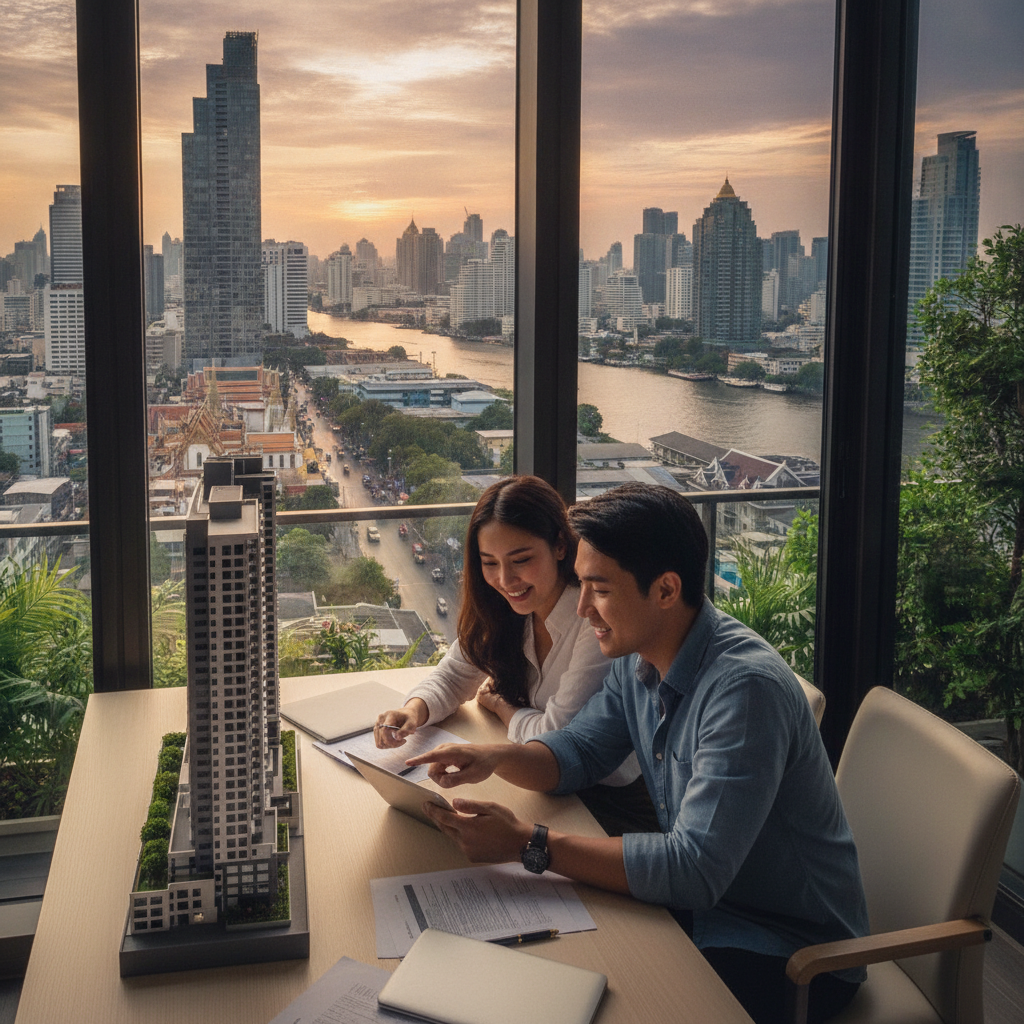
Schedule a Private Floor Plan Analysis or In-Person Residence Viewing
If you have identified a specific Bangkok neighborhood, building type, or budget threshold from this guide, the most efficient next step is a structured floor plan review matched to your long-stay configuration requirements — not a generic property portal search that surfaces every listing regardless of foreign quota status, building management quality, or proximity to your specific infrastructure priorities.
We arrange private, no-commitment viewings and documentation reviews for qualified long-stay buyers across Bangkok's five primary foreign-buyer corridors. Our process begins with a 20-minute intake call to map your visa category, intended annual residency duration, budget range, and preferred district — and ends with a curated shortlist of three to five properties where foreign quota availability, building management track record, and your personal long-stay use case align precisely.
- Private in-person viewings scheduled within 48 hours across Sukhumvit, Sathorn, Riverside, Ratchada, and Rama 9 corridors
- Foreign quota status verified in real time before any viewing is arranged
- FET remittance process and 2026 DBD documentation requirements explained in full before you commit to any transaction
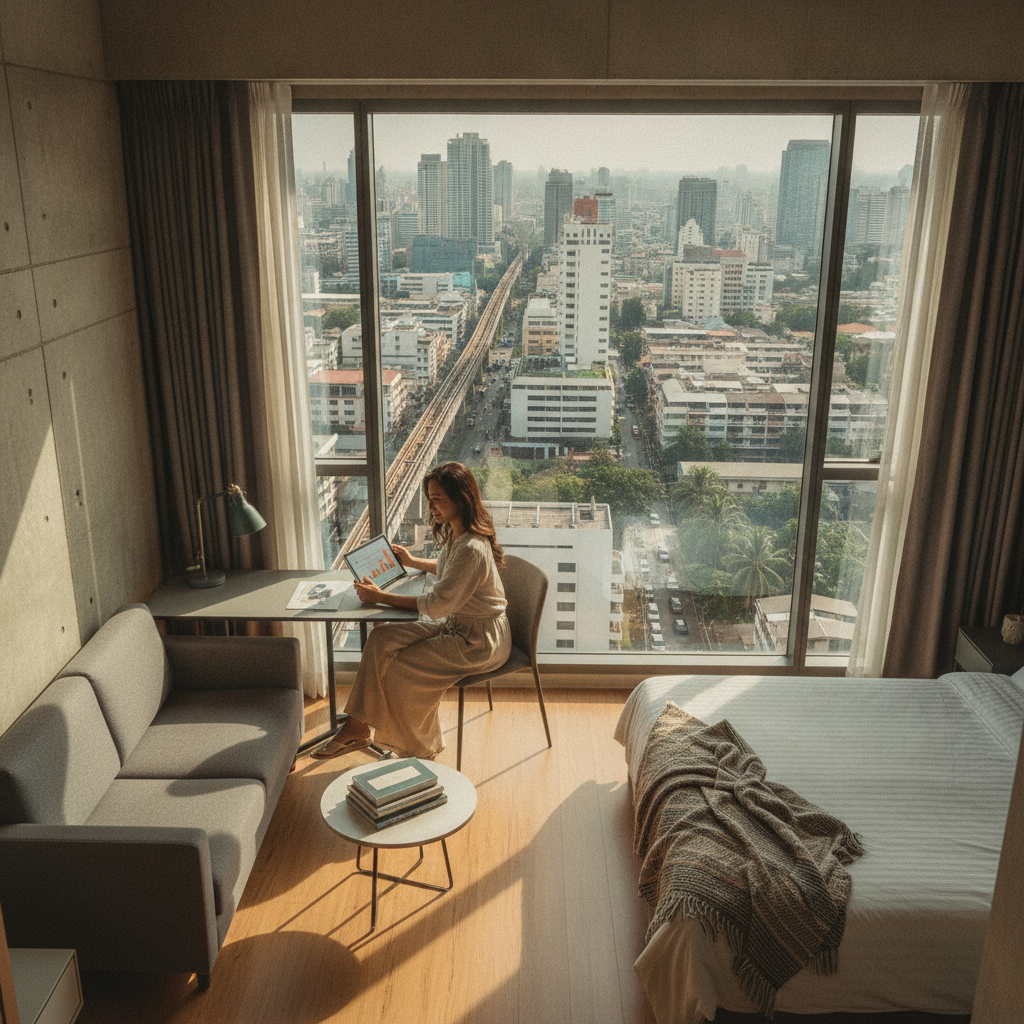
- Floor plan analysis with furniture layout consultation for 65–85 sqm two-bedroom long-stay configurations
- Introduction to Bangkok-based bilingual legal counsel specializing in foreign freehold condo transactions
To request your private viewing or floor plan analysis, contact us directly with your preferred corridor, budget range, and intended move-in timeline. Response within 4 business hours. No developer referral fees charged to buyers. Your inquiry is handled with full confidentiality.