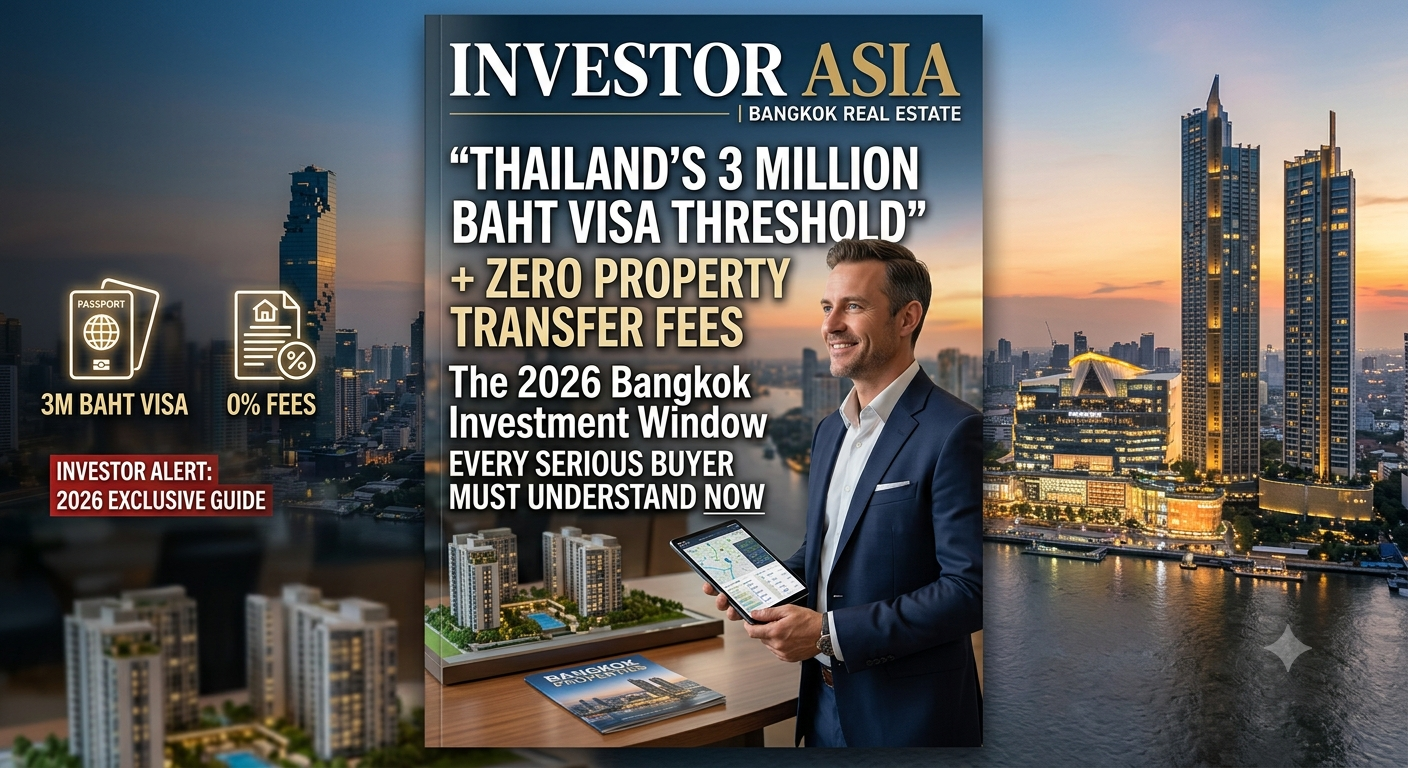
Thailand's 3 Million Baht Visa Threshold + Zero Property Transfer Fees: The 2026 Bangkok Investment Window Every Serious Buyer Must Understand Now

The Policy Collision That Changes Bangkok's Foreign Buyer Equation
Two separate government instruments — Thailand's revised long-term residency visa threshold and the Finance Ministry's extended property fee waiver — have landed on the same calendar in 2026. The result is a hard, quantifiable cost reduction for any foreign national purchasing residential property in Bangkok right now.
The visa pathway that previously demanded a significantly higher committed investment has been recalibrated to a 3 million baht qualifying asset value. Stack that against transfer fees slashed from 2% to 0.01% and specific business tax reductions still active through 2027, and the arithmetic changes materially for buyers who have been watching from the sidelines.
This is not a promotional narrative. These are Thai government gazette announcements. The question is whether your property selection actually qualifies under the precise eligibility criteria — because not every Bangkok condominium unit, in every building, on every title deed type, satisfies all conditions simultaneously.
Insider Property Insight: Foreign buyers frequently confuse the qualifying investment value with the registered transfer price. Thai authorities assess eligibility against the appraised value on the land department's official table — not the negotiated market price on your contract. In several Bangkok districts, the land department appraisal sits 15–25% below actual transaction prices, meaning your real expenditure to hit the 3 million baht threshold may be higher than the headline figure suggests. Always verify the specific unit's appraised value before structuring a visa-linked purchase.
Decoding the True Value of Bangkok's 2026 Visa-Property Incentive Stack
The 3 million baht visa mechanism Thailand has activated sits within the Long-Term Resident (LTR) Visa framework introduced by the Board of Investment. To qualify under the Wealthy Global Citizen or Wealthy Pensioner categories using property investment, the asset must be a condominium unit under the Condominium Act — not landed property, not leasehold under a Thai company structure, and not a pool-title resort unit sold under a hotel licence.
This is where Bangkok's grade-A freehold condominium inventory becomes directly relevant. Units held under a clean foreign freehold title (the 49% quota allotted to non-Thai nationals under Section 19 of the Condominium Act) are the only category that satisfies the BOI's asset verification requirement without additional legal restructuring.
What Neighbourhoods and Building Tiers Actually Qualify at the 3M Threshold?
At 3 million baht, the Bangkok market segments sharply. In Sukhumvit's prime inner corridor (BTS Asok to Phrom Phong), 3 million baht purchases a studio or compact one-bedroom unit in a mid-tier building — frequently an older asset with depreciated common areas and limited resale liquidity to non-Thai buyers.
In emerging but well-infrastructure-connected corridors — Ratchadaphisek, Lat Phrao intersection, or the Rama 9 CBD zone — the same budget accesses newer builds with stronger rental demand from Bangkok's growing corporate expatriate community. These zones are generating gross rental yields of 5.2–6.8% annually on one-bedroom units according to 2025 transaction data, outperforming the Sukhumvit prime corridor's compressed 3.8–4.5% yields driven by oversupply in the luxury segment.
For buyers targeting visa qualification at the minimum threshold, the strategic play is not to buy the cheapest qualifying unit — it is to buy the unit in the sub-market with the highest rental velocity, ensuring the asset works as an income instrument while it satisfies the residency requirement.
- Rama 9 / Ratchadaphisek Zone: Highest corporate tenant demand, proximity to the new CBD clustering of international firms, and land department appraisal values climbing faster than transaction prices — meaning visa qualification becomes easier over time as appraised values close the gap.
- On Nut to Udomsuk Corridor: The highest concentration of foreign freehold quota availability in newly completed buildings, with 3M–4.5M baht price points accessing genuine one-bedroom units above 35 sqm.
- Lat Phrao / Union Mall Intersection: Undervalued by the expat community but heavily tenanted by Thai corporate professionals and Japanese expat families, producing stable long-term lease income with lower vacancy risk.
Does Buying Property in Thailand Give You a Visa?
Does buying property in Thailand automatically give you a visa?
Purchasing property in Thailand does not automatically grant a visa. Foreign nationals must apply separately to the BOI under the LTR Visa programme, submitting proof of qualifying property ownership valued at a minimum 3 million baht under a foreign freehold condominium title, alongside financial health and insurance documentation.
The distinction matters enormously for purchase timing. Buyers who close on a unit and then apply for the LTR Visa must ensure their title transfer is fully registered at the Land Department — with the chanote (title deed) bearing their name — before submitting the visa application. The BOI does not accept a sale and purchase agreement, a reservation receipt, or a developer's letter of intent as proof of qualifying investment.
This creates a sequencing risk in off-plan purchases. If you reserve a unit in a project scheduled for completion in Q3 2027 and transfer fees revert to standard rates before your title registers, you lose the fee incentive. Buyers motivated by the combined visa-plus-fee-saving opportunity should focus exclusively on completed, ready-to-transfer inventory where the Land Department registration can happen within weeks, not years.
Seamless Living: BTS, MRT, and the Bangkok Districts That Deliver Both Connectivity and Visa-Qualifying Inventory
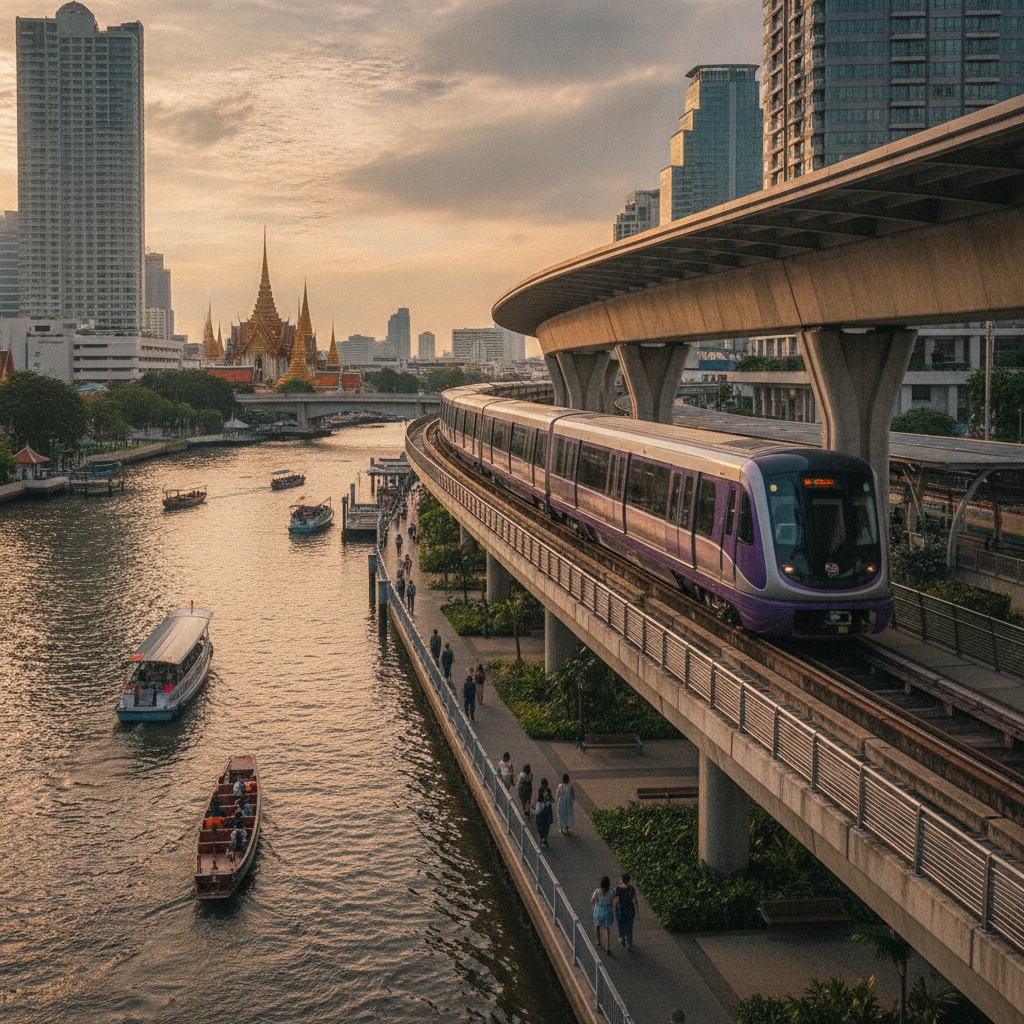
Bangkok's mass transit network has matured enough that the old premium attached exclusively to Sukhumvit BTS corridor properties no longer reflects the full livability picture. The MRT Blue Line extension and the Orange Line under active construction have fundamentally redrawn commute-time maps for the Rama 9, Ratchadaphisek, and Lat Phrao districts.
- MRT Phetchaburi (Rama 9 Zone): Direct interchange connectivity to Asok/Sukhumvit and Hua Lamphong. Average walk time to station from new residential towers in this micro-zone: 4–9 minutes. Corporate tenant pool: AIA, PwC, Mazda Thailand, and over 40 registered multinational regional headquarters within 1.2 km radius.
- MRT Ratchadaphisek: Access to the Bangkok CBD via single-line direct ride, with the Esplanade and Central Rama 9 retail anchors providing F&B and lifestyle retail that reduces car dependency to near-zero for daily living.
- BTS On Nut: The benchmark of established expat community density outside the prime Sukhumvit corridor. Gateway Ekamai market, Tops Supermarket, and a cluster of international schools within 3 km. Highest concentration of ready-to-transfer, foreign-freehold-quota-available inventory in the sub-3.5M baht range.
- MRT Lat Phrao 71 / Lat Phrao 83 (future Orange Line stations): Forward-buying opportunity. Units purchased now at pre-transit-premium pricing with LTR Visa qualification potential — a two-layered value thesis for the investor buyer.
The critical filter for any visa-motivated purchase is not just which BTS or MRT station is nearest, but whether the specific building's units remain within the 49% foreign freehold quota. Buildings that have sold heavily to foreign buyers in prior years may have exhausted quota entirely, making LTR Visa-qualifying purchases structurally impossible regardless of unit price.
Bangkok Rental Yields, Foreign Freehold Quotas, and the 2027 Transfer Fee Deadline: What Market Conditions Actually Look Like Right Now
Bangkok's residential investment market in 2026 is operating under conditions that favour decisive buyers over patient observers. Three forces are compressing the window: the LTR Visa threshold at its current 3 million baht floor is subject to policy review, property transfer fee reductions revert in 2027, and foreign freehold quota availability in well-located completed buildings is contracting as domestic demand for units with clean foreign-title history increases.
Current Rental Yield Benchmarks by Zone (2025–2026 Transaction Data)
- Sukhumvit Prime (Asok–Phrom Phong): 3.8–4.5% gross yield. High liquidity, high entry cost, compressed return. Best for capital preservation, not income generation.
- Rama 9 / New CBD: 5.2–6.8% gross yield on one-bedroom units. Strongest corporate tenant demand of any Bangkok sub-market. Recommended for buyers prioritising income yield alongside visa qualification.
- On Nut / Phra Khanong: 5.0–5.9% gross yield. High expat tenant occupancy, strong sub-lease demand from Japanese and Korean professionals. Units move within 2–3 weeks of listing at correct price points.
- Lat Phrao Corridor: 4.8–5.5% gross yield currently, with anticipated uplift of 0.8–1.2 percentage points upon Orange Line station opening based on precedent set by MRT Blue Line impact on Ratchadaphisek values (2019–2022).
The Foreign Freehold Quota — The Variable Nobody Discusses Loudly
Under Thai Condominium Act Section 19, foreign nationals may collectively own no more than 49% of a building's total floor area. In Bangkok's most desirable completed buildings — particularly those with genuine lifestyle amenity stacks (lap pools above the 20th floor, co-working infrastructure, EV charging, hotel-managed services) — foreign quota availability is not guaranteed.
Any buyer who completes a purchase in the Thai-name quota (50.1% of floor area reserved for Thai nationals) and subsequently attempts to use that unit for LTR Visa qualification will find the application rejected. The BOI is explicit: the qualifying condominium must be owned under a foreign freehold title. Due diligence on quota status is therefore not optional — it is the foundational verification step before any offer is made.
Request the building's current foreign-to-Thai ownership ratio from the juristic person manager, not the developer's sales team. The juristic person holds the legally binding record. In buildings where the ratio is at or approaching 48%, a buyer may find their unit purchase triggers the quota cap and their title registers as Thai-name by default — a scenario that has occurred in popular Sukhumvit buildings and invalidated intended visa applications after the fact.
Schedule a Private Consultation on Visa-Qualifying Bangkok Properties: Floor Plans, Quota Status, and Fee Calculations Provided
The 3 million baht visa threshold and the extended transfer fee reduction are not indefinite. Policy windows in Thailand's property and immigration landscape move on government timelines, not buyer timelines.
If you are a foreign national evaluating Bangkok residential property for LTR Visa qualification, income yield, or long-term capital positioning, the next step is not another article — it is a structured conversation about specific units, in specific buildings, with verified foreign freehold quota availability and confirmed land department appraised values at or above the qualifying threshold.
We provide:
- Curated shortlists of completed, ready-to-transfer Bangkok condominiums with confirmed foreign freehold quota availability
- Land department appraised value verification for each shortlisted unit before you invest time in viewings
- Transfer fee calculations under current reduced rates versus post-2027 standard rates — so you see the exact baht value of acting within the window
- LTR Visa eligibility pre-screening in coordination with BOI-registered legal advisors
- Private in-person viewings arranged within 48 hours for qualified buyers
There is no obligation and no hard sales process. The market data and unit specifics speak for themselves when structured correctly.
Request your private property consultation and floor plan analysis today. Provide your target budget, preferred Bangkok district, and intended use (primary residence, rental income, or visa qualification), and we will respond with a tailored shortlist within one business day.