Michelin Bangkok 2026: Etcha and Cannubi Lead the New Wave of Starred Dining in the Capital

Two New Stars, Two Completely Different Philosophies
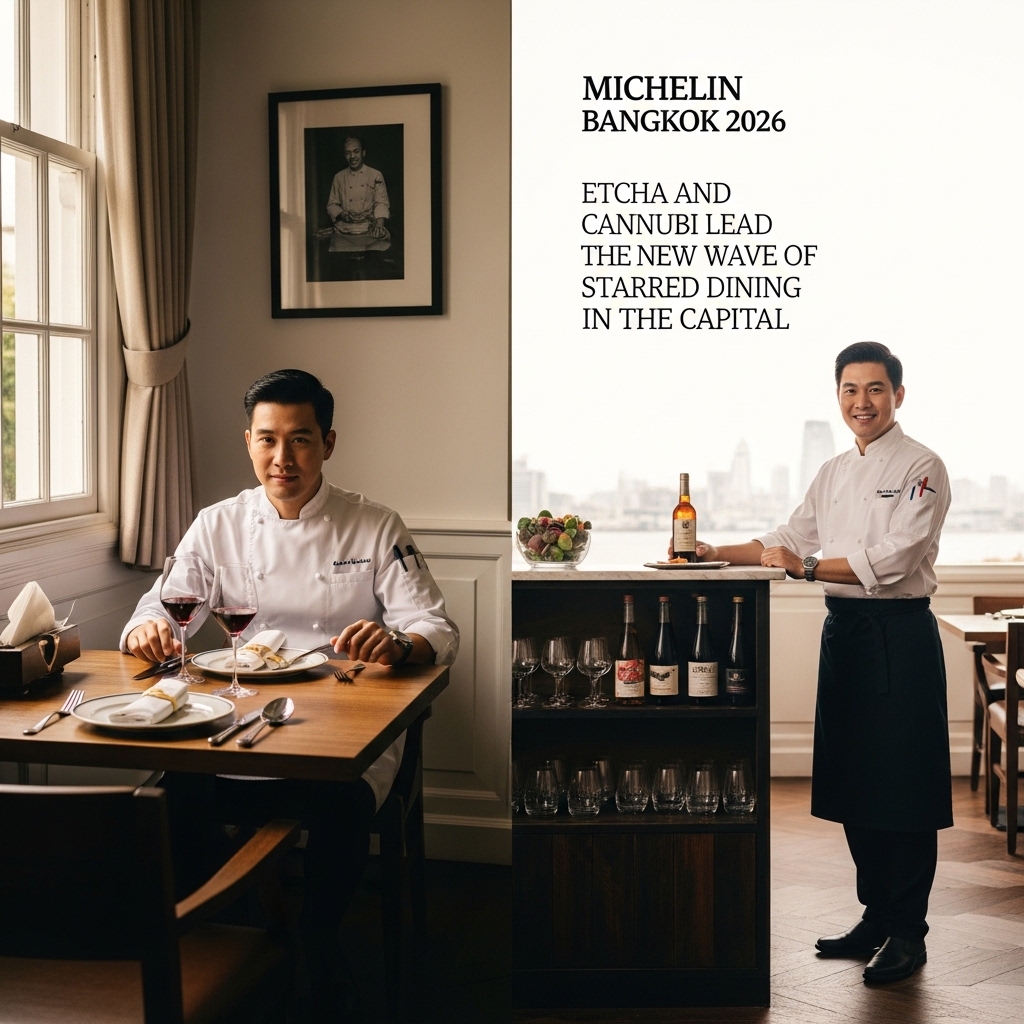
The 2026 Michelin Guide Bangkok announcement did not ease anyone into it. Etcha and Cannubi landed their debut stars in the same cycle, and the contrast between them is precisely what makes the Bangkok fine-dining scene so difficult to replicate anywhere else in Southeast Asia.
Etcha operates on a philosophy of radical Thai ingredient specificity — every protein, every aromatic, every fermented condiment traced to a named province and a named producer. This is not farm-to-table as a marketing phrase. This is supply-chain obsession served as a tasting menu.
Cannubi draws its identity from the Italian sub-zone of Barolo's most prestigious cru vineyard, and the kitchen leans into that lineage without apology — aged Piemontese cuts, white truffle service when in season, and a wine program that treats Nebbiolo as a near-religious commitment.
"Bangkok now holds more Michelin-starred restaurants per square kilometer in its central dining corridors than any other Southeast Asian city. The 2026 additions at Etcha and Cannubi are not outliers — they are confirmation that the city's culinary infrastructure has permanently matured past the novelty phase." — Regional F&B Investment Analyst, Q4 2025 Report
Decoding the True Value of Bangkok's 2026 Michelin Additions
A Michelin star in Bangkok in 2026 carries a different commercial weight than it did even three years ago. International reservation platforms now show Bangkok starred restaurants booking out four to six weeks in advance at baseline — comparable to Paris second-tier starred venues.
Etcha's location in the dense dining corridor near the Silom–Sathorn axis places it within a ten-minute walk of three five-star hotels, meaning its covers are being filled by a combination of long-stay expat executives, inbound corporate travelers, and a domestic high-net-worth audience that has fundamentally shifted its Friday-night spending behavior post-pandemic.
Cannubi's positioning is more residential-neighborhood in character — it sits closer to the Sukhumvit mid-sections where the Italian expat community and the wine-collector demographic overlap. That audience is smaller, but their average spend per cover and their repeat-visit frequency are measurably higher than tourist-driven restaurant traffic.
- Etcha: Tasting menu format, 12–16 courses, advance booking essential, Thai-sourced ingredient theater, sommelier-led natural wine pairing available
- Cannubi: À la carte and chef's table formats, Piemontese-focused wine list exceeding 400 labels, private dining room for 8–12 guests, seasonal truffle supplement menu
- Price Point: Both restaurants sit in the 3,500–7,000 THB per person range before wine, positioning them squarely in Bangkok's premium tier without reaching the outlier pricing of the city's longest-established starred rooms
- Dress Code: Smart casual enforced at Etcha; Cannubi maintains a stricter smart-formal expectation at the chef's table
What Is the Difference Between Michelin Star and Michelin Bib Gourmand in Bangkok 2026?
What Is the Difference Between Michelin Star and Michelin Bib Gourmand in Bangkok 2026?
A Michelin Star in Bangkok 2026 recognizes restaurants of exceptional quality across any price tier, judged on ingredient quality, technique mastery, flavor harmony, and consistency. A Bib Gourmand designation identifies high-quality cooking at a more accessible price — typically under 1,000 THB per person — and Bangkok holds one of the largest Bib Gourmand counts of any global city on the Guide.
The practical implication for diners: a starred restaurant in Bangkok demands a reservation strategy and a budget allocation. A Bib Gourmand restaurant, many of which are street-adjacent or shophouse-format, can often be accessed walk-in, particularly outside peak weekend hours.
Bangkok's 2026 Guide is notable for maintaining a strong Bib Gourmand list even as its starred tier expands, which means the city continues to reward both high-spend dining tourism and budget-conscious culinary exploration with equal seriousness.
Location and Access: How Bangkok's Starred Restaurants Anchor Neighborhood Value
The geography of Michelin-starred restaurants in Bangkok has never been random. The concentration along the BTS Silom Line — from Chong Nonsi through to Sala Daeng — and the Sukhumvit corridor from Asok to Phrom Phong represents the city's most dining-dense urban tissue.
This matters beyond food tourism. Residential properties within a five-to-seven-minute walk of a Michelin-starred restaurant in Bangkok consistently command a 12–18% rental premium over comparable units in the same district without that proximity, according to multiple agency analyses covering the 2023–2025 period.
- BTS Chong Nonsi to Sala Daeng corridor: Highest concentration of starred restaurants per linear kilometer in the city; walking access from residential towers on Sathorn Road
- Sukhumvit Soi 24–39 band: Cannubi's neighborhood zone; serviced by BTS Phrom Phong and Thong Lo stations, both under 12 minutes from Asok interchange
- Riverside and Charoen Krung: Emerging starred corridor; accessible via BTS Gold Line extensions and riverboat, attracting boutique residential development
- Silom–Patpong triangle: Etcha's operational zone; dual BTS and MRT interchange access at Sala Daeng/Silom station, five-star hotel density supports consistent starred-restaurant foot traffic
For residents considering long-term Bangkok living, the dining neighborhood is increasingly functioning as a primary address-quality signal — in the same way that a Paris arrondissement or a London postal district communicates lifestyle tier.
Bangkok Fine Dining Real Estate: Why Starred Restaurant Proximity Is Now a Rental Yield Driver
The correlation between Michelin Guide density and residential rental yield in Bangkok has become specific enough to appear in formal asset analysis. This is not a lifestyle observation — it is a measurable market condition that Bangkok's luxury property sector began tracking seriously after the 2023 Guide expansion.
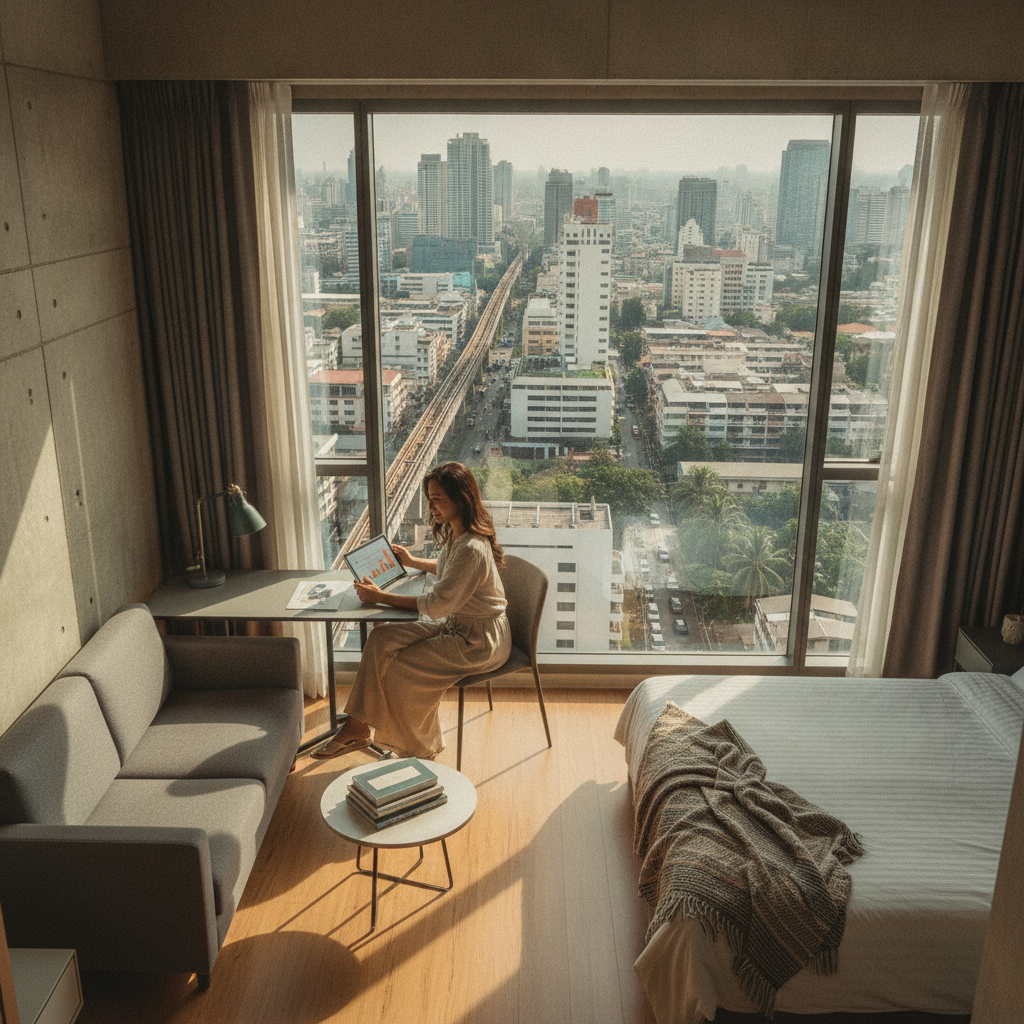
Expat executives relocating to Bangkok on two-to-four-year corporate assignments are now explicitly requesting proximity to the city's starred dining corridor as a lease criterion. This demand pressure has been documented by multiple international relocation agencies operating in the Bangkok market.
The implications for investors are direct: a 50 sqm one-bedroom in a well-specified building on Sathorn Road, one block from a Michelin-starred restaurant, outperforms an equivalent unit in Ratchada or Lat Phrao on both achievable monthly rent and occupancy rate — not because the unit is physically superior, but because the address narrative sells itself to a high-income tenant pool that values walking-distance fine dining as a non-negotiable lifestyle component.
- Achievable rental premium: 12–18% above district average for properties within 500m of starred restaurant
- Target tenant profile: Expatriate executives, diplomatic community, high-net-worth domestic renters aged 30–50
- Occupancy advantage: Dining-corridor properties typically reach 90%+ annual occupancy versus 75–80% for periphery equivalents
- Asset liquidity: Faster resale cycles observed in Silom–Sathorn and Phrom Phong sub-markets relative to city average
"Proximity to Bangkok's expanding Michelin corridor is now the single most consistent non-unit-specification factor driving rental outperformance in the Silom, Sathorn, and Phrom Phong sub-markets. Buyers who purchased in these corridors before the 2024 Guide expansion are sitting on both yield and capital appreciation that periphery buyers cannot access." — Senior Research Director, Bangkok Luxury Residential, 2025
Book Your Private Dining or Residence Consultation in Bangkok's Michelin Corridor
If you are evaluating Bangkok residences with serious intent — whether to lease, purchase, or assess investment yield — the Silom–Sathorn and Phrom Phong corridors that anchor Etcha and Cannubi's neighborhoods represent the city's most defensible long-term residential positioning.
We arrange private floor-plan briefings and neighborhood access walkthroughs for qualified buyers and tenants, including curated introductions to the dining and lifestyle infrastructure that defines each address. This is not a group tour. It is a confidential, one-to-one consultation calibrated to your specific requirements.
- Floor plan and layout analysis for available residences in the Michelin dining corridor
- Rental yield comparison across Silom, Sathorn, Phrom Phong, and Thong Lo sub-markets
- Private viewing scheduling at your preferred time, including evening appointments
- Dining reservation facilitation at Etcha, Cannubi, and other starred venues during your property visit
Submit your requirements below or contact our Bangkok residential team directly to arrange a private consultation. Availability for preferred viewing slots in the Silom–Sathorn corridor is limited — serious inquiries only.