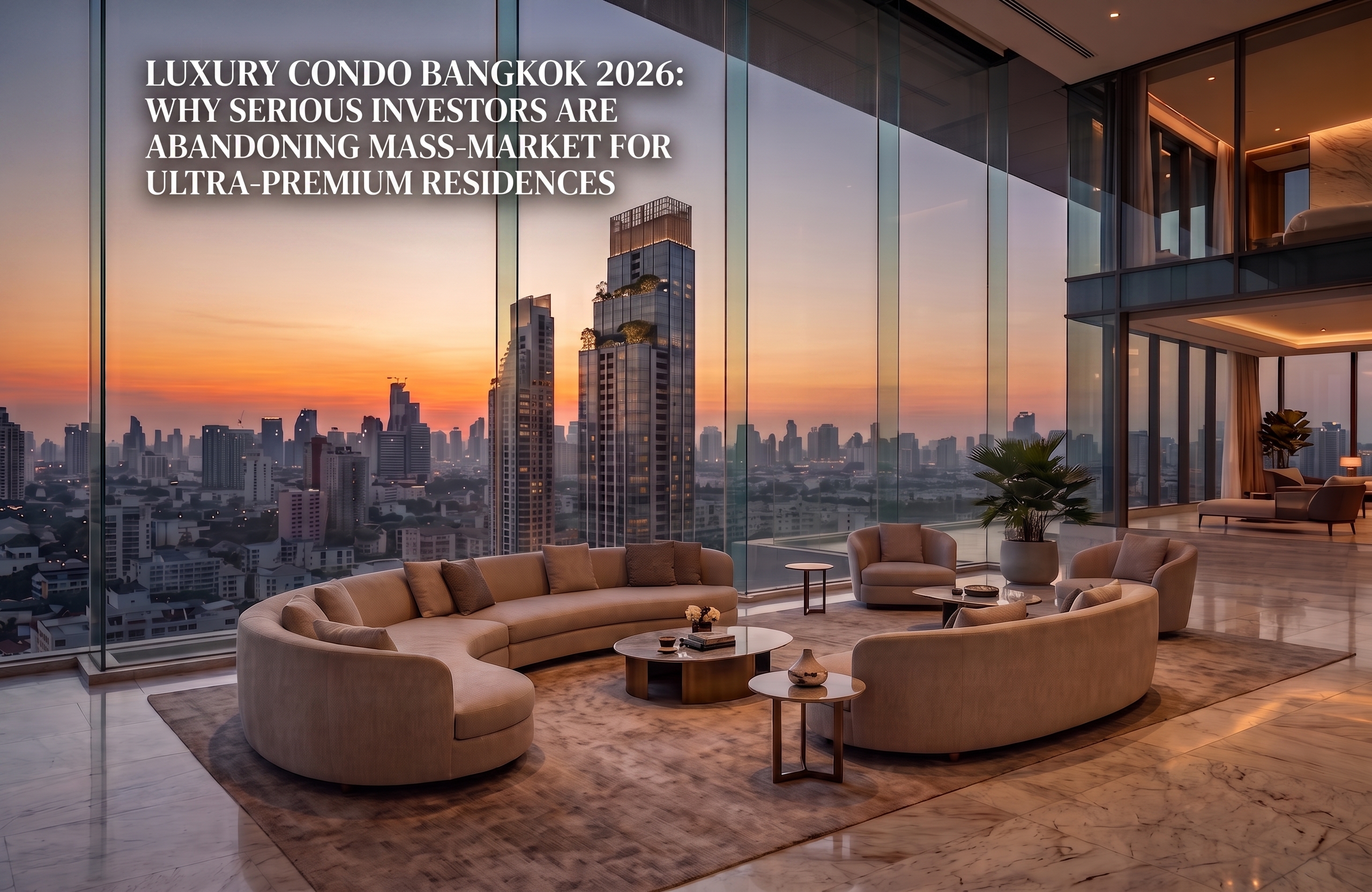
Luxury Condo Bangkok 2026: Why Serious Investors Are Abandoning Mass-Market for Ultra-Premium Residences

Bangkok's Two-Speed Property Market Is No Longer a Theory—It's Live Data
While Bangkok's sub-฿5M condominium segment continues to absorb unsold inventory from 2022–2024 pipeline launches, the city's ultra-luxury tier—units priced above ฿200,000 per square metre—recorded absorption rates that institutional analysts are calling structurally unprecedented for a Southeast Asian capital.
The divergence is not cyclical noise. It is a permanent bifurcation driven by four convergent forces: the collapse of Thai domestic mortgage credit for mid-tier buyers, an accelerating HNWI relocation wave from Hong Kong and Singapore seeking Bangkok's comparatively accessible freehold ownership structures, a tightening land-to-floor-area ratio in the CBD that makes genuine luxury supply physically constrained, and a post-pandemic lifestyle reprioritisation among C-suite executives who now treat their primary residence as an operational infrastructure decision, not merely a shelter purchase.
Understanding this split is not optional intelligence for a 2026 property investor. It is the entry-level prerequisite for deploying capital intelligently in this market.
Insider Insight: Bangkok's Grade-A luxury supply pipeline for 2026–2028 totals fewer than 2,800 units across the entire Sukhumvit, Silom, and Riverside corridors combined. In a metro of 11 million people with a rapidly expanding expatriate HNWI base, that figure represents a structural supply ceiling that mass-market oversupply cannot offset—and it is the single most important number sophisticated buyers are not discussing loudly enough.
Decoding the True Value of Ultra-Premium Bangkok Residences in 2026
What separates a luxury Bangkok condo from a premium-priced mass-market unit?
A luxury Bangkok condominium in 2026 is defined by land-constrained CBD positioning, a floor-plate ratio below 20 units per floor, branded amenity programming, ceiling heights above 3.2 metres, and developer-curated material specifications that cannot be replicated at sub-฿150,000-per-sqm price points. Price alone is not the differentiator—scarcity architecture is.
The performance gap between genuine luxury assets and aspirationally priced mid-tier product has become measurable in three hard metrics: rental yield compression resistance, capital value retention during down cycles, and days-on-market at resale. Premium residences in the Asok–Phrom Phong corridor consistently resell within 45 days at or above original acquisition cost when the underlying land value per rai exceeds ฿500M—a threshold that functionally eliminates competing new supply on adjacent plots.
What institutional capital has identified—and what individual investors are now rapidly pricing in—is that Bangkok luxury condominiums are not simply expensive apartments. They are leveraged positions on irreplaceable urban land in a city whose CBD boundaries are effectively fixed by the Chao Phraya River to the west, elevated expressways to the north, and fully developed commercial blocks to the east and south.
The Amenity Architecture That Commands the Premium
The amenity gap between a ฿120,000/sqm and a ฿220,000/sqm Bangkok residence has widened dramatically since 2023. Where legacy luxury buildings offered a rooftop pool and a co-working lounge, today's benchmark properties are delivering private sky-gardens with curated horticulture, on-call butler services with restaurant-quality F&B delivery, dedicated EV charging infrastructure per unit, biometric-secured private lift lobbies, and acoustically engineered floor-to-ceiling glazing rated for Bangkok's ambient urban noise spectrum.
These are not marketing differentiators. They are retention mechanisms. Residents who live in buildings with this calibre of operational infrastructure demonstrate renewal rates above 80% on rental tenancies and hold periods averaging 7.2 years on owner-occupier purchases—statistics that compress vacancy risk to near zero and provide landlords with bargaining leverage on annual rent escalation that mass-market landlords simply cannot replicate.
The buildings that will outperform across the 2026–2030 hold period are those where the amenity package was engineered for the specific lifestyle requirements of relocated C-suite executives, HNWI families with school-age children, and short-stay ultra-premium corporate tenants—not designed generically for a hypothetical Thai middle-class buyer who increasingly cannot access mortgage financing regardless of aspirational appeal.
Why Are High-Net-Worth Investors Choosing Bangkok Luxury Condos Over Other Asian Markets?
Why are high-net-worth investors choosing Bangkok luxury condos over other Asian markets in 2026?
Bangkok luxury condominiums offer freehold foreign ownership at 49% of total units, zero capital gains tax, no annual property tax above residential thresholds, and per-square-metre entry prices 40–60% below comparable Singapore and Hong Kong Grade-A product—with H1 2026 showing 15% YoY appreciation in the premium segment.
The comparative tax architecture is where Bangkok's competitive advantage crystallises most sharply for international capital allocation. Singapore's Additional Buyer's Stamp Duty for foreigners now sits at 60%. Hong Kong's equivalent charge effectively prices most foreign buyers out of the primary market. Bangkok levies no equivalent punitive surcharge on foreign freehold condo purchases within the 49% foreign quota framework.
The practical consequence: a Singapore-based family office deploying USD 2M into residential property retains dramatically more net asset exposure in Bangkok than in any other Tier-1 Asian city. When that capital advantage is combined with Bangkok's expanding roster of international schools, its direct flight connectivity to 180+ global destinations via Suvarnabhumi, and its rapidly maturing luxury retail and dining infrastructure along the Sukhumvit spine, the investment thesis stops requiring justification. It begins requiring only execution.
Seamless Living: Transit Proximity and the Lifestyle Infrastructure That HNWI Tenants Demand
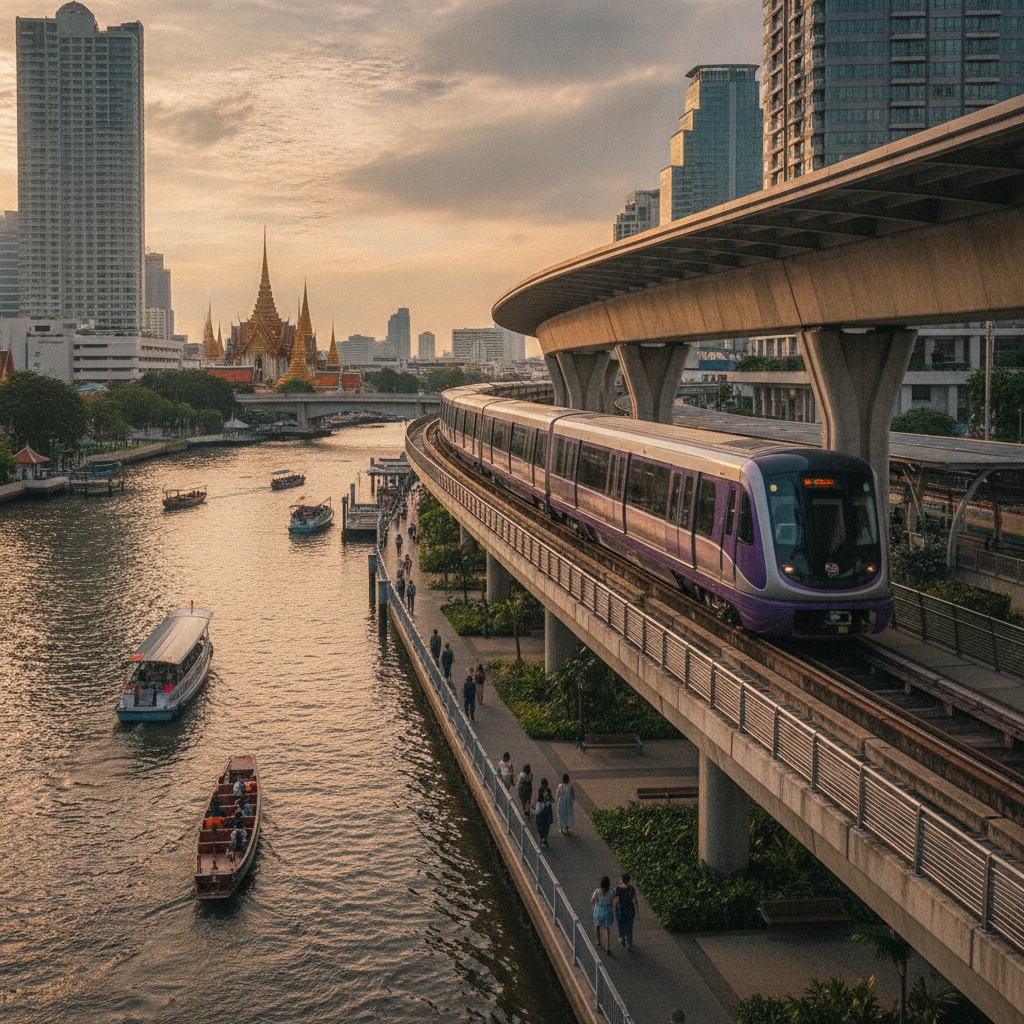
The luxury Bangkok resident of 2026 does not tolerate infrastructure friction. The buildings commanding top-of-market rental yields—consistently between 4.2% and 5.8% gross in the Asok–Thonglor–Ekkamai corridor—share one non-negotiable characteristic: they are within a covered, climate-controlled walking radius of a BTS Skytrain or MRT interchange station.
This is not a lifestyle preference. It is a tenant qualification filter. Corporate relocation packages for senior executives increasingly specify transit-proximate housing as a hard requirement, not a nice-to-have. Buildings that cannot satisfy this condition are simply excluded from shortlists before a viewing is ever arranged.
The access infrastructure that premium Bangkok residences deliver to their residents includes:
- BTS Skytrain access within 300 metres: Direct, air-conditioned connectivity to Siam, Silom, and Asok business nodes without ground-level traffic exposure—critical for executives managing 7AM and 9PM schedules simultaneously.
- Proximity to international medical facilities: Bumrungrad International Hospital (Nana), Samitivej (Sukhumvit 49), and Bangkok Hospital Medical Centre form a care triangle across the luxury corridor that relocation advisors cite as the single most frequently referenced quality-of-life factor by incoming HNWI families.
- International school clusters within a 15-minute chauffeured radius: NIST, Bangkok Patana, Shrewsbury, and Wells International School position the Sukhumvit luxury belt as the default residential choice for families with school-age children—generating a tenant demand floor that survives economic downturns.
- Premium retail and F&B density: EmQuartier, Emporium, Terminal 21 Asok, and the Thonglor boutique dining corridor provide the curated lifestyle infrastructure that differentiates Bangkok's luxury residential zones from comparable product in secondary Thai cities.
- Airport expressway and tollway access points: For residents managing regional business travel, connectivity to Suvarnabhumi via the elevated expressway network—accessible without surface-road exposure—is a silent premium that experienced Bangkok residents price heavily.
Buildings that can place a resident at their airline gate within 35 minutes from front door to airside command a rental premium that their competitors located three BTS stops further cannot arithmetically close regardless of interior specification.
Premium Segment Rental Yields, Floor Plan Analysis, and the Market Conditions Defining 2026 Returns
The rental yield narrative for Bangkok luxury condominiums in 2026 requires precision, because the aggregate market figure obscures the performance disparity between buildings that were correctly specified for their target tenant and those that were not.
At the portfolio level, Grade-A luxury Bangkok condominiums—defined as buildings with branded common areas, 24-hour concierge, smart-home integration, and land value above ฿400M per rai—are generating gross rental yields between 4.2% and 5.8% as of H1 2026. Net yields after common area charges and management fees settle in the 3.4%–4.6% range for owner-operated landlords and slightly lower for those using professional letting management.
These figures become significantly more compelling when modelled against capital appreciation. The same segment recording 15% YoY appreciation in H1 2026 produces a total return profile that exceeds Bangkok's luxury serviced apartment market, outperforms Thai government bond yields by a material spread, and does so with an asset that can be physically occupied, enjoyed, and leveraged as collateral in ways that financial instruments cannot replicate.
Floor Plan Typologies That Outperform in the Luxury Rental Market
Not all luxury floor plans perform equally. The 2026 premium rental market in Bangkok is expressing clear preferences that investors ignoring typology are discovering painfully at vacancy review.
- Two-bedroom, 75–95 sqm configurations: The dominant demand unit for dual-income expatriate couples and small families. These command the highest rent-per-sqm ratios in the luxury tier and carry the lowest vacancy exposure of any configuration.
- Three-bedroom, 130–180 sqm configurations: The tier most insulated from mass-market competition, driven by families who require live-in domestic helper accommodation within the unit—a requirement that eliminates approximately 80% of Bangkok's condominium stock from consideration immediately.
- Penthouse and sky-villa typologies above 250 sqm: A thin but exceptionally resilient demand pool of ultra-HNWI residents and corporate housing programmes for CEO-level executives. Days-on-market at this tier average 90+ days but achieved rents are negotiated with zero downward pressure by landlords holding irreplaceable product.
- One-bedroom configurations below 55 sqm: The least defensible luxury positioning. Vulnerable to competition from boutique serviced apartments and co-living operators who can match specification at lower all-in cost for the single professional tenant.
The most sophisticated Bangkok luxury investors in 2026 are not asking which building to buy in. They are asking which floor, which stack, which ceiling height differential, and which unit typology within the building optimises their specific hold period, exit strategy, and target tenant profile. That level of granularity is what separates a 4.8% net yield from a 3.1% net yield in an otherwise identical address.
Market Intelligence: In Bangkok's luxury segment, units on floors 20 and above with unobstructed city or river views command a rental premium of 12–18% over equivalent-specification units on lower floors within the same building. This premium has proven remarkably stable across Bangkok's economic cycles since 2015—making vertical positioning within a building a more reliable value driver than many buyers initially model.
Schedule a Private Floor Plan Analysis or Viewing of Available Premium Residences
If the data in this analysis has confirmed what you have been sensing about Bangkok's luxury property market in 2026, the next step does not require a financial commitment—it requires a conversation.
The residences that are outperforming the market metrics described above are not discovered through portals. They are accessed through direct relationships with advisors who carry verified access to pre-market listings, developer-direct bulk negotiation capacity, and the building-specific performance data that publicly available listing platforms are neither structured nor incentivised to provide.
We offer two entry points for serious buyers and investors at this stage:
- Private Floor Plan Analysis Session (60 minutes, no obligation): A structured walkthrough of available unit typologies, stack-specific view analysis, yield modelling against your target hold period, and a side-by-side comparison of the three buildings in your target corridor that are currently producing the strongest verified tenant demand. This session is conducted in complete confidence and without sales pressure of any kind.
- Exclusive In-Building Private Viewing: For buyers who have identified a target building or corridor, we arrange access to available residences outside of standard open-hour protocols—including show units not listed publicly and resale units whose owners have authorised discreet, pre-market presentation to qualified buyers only.
Both options are available within 48 hours of your inquiry. No group tours. No bulk email follow-ups. No junior-agent handoffs.
To arrange your private viewing or floor plan analysis, submit your preferred residence typology, target budget, and intended hold period through our confidential inquiry form. A senior advisor will respond within four business hours with available options matched precisely to your criteria.
The Bangkok luxury market in 2026 is not waiting. The supply ceiling is real, the demand floor is expanding, and the buyers who move on verified data in the next 90 days will be the sellers setting the benchmark comparables in 2029.