Foreigner's Guide to Bangkok Condos in 2026: Rules, Taxes & Smart Moves

Why 2026 Is a Defining Year to Buy Bangkok Condos as a Foreigner
Foreign demand for Bangkok condos hit a post-pandemic high in 2024, and 2026 is the inflection point where tightening foreign quota availability meets a wave of newly completed Grade-A towers along the Sukhumvit, Silom, and Riverside corridors. If you are waiting for prices to dip, the data says the opposite is happening — fast.
The Thai government's long-term resident visa programme, alongside sustained Chinese, Hong Kong, and European buyer inflows, has systematically absorbed the freehold foreign quota in premium projects across the CBD. Buildings that were 60% unsold at launch in 2022 are now reporting less than 8% foreign quota remaining.
Understanding exactly which buildings retain legal foreign quota, which titles are clean for offshore fund transfer, and which locations command durable rental yields above 5% annually — that is the intelligence this guide delivers, section by section.
Insider Property Insight: In Bangkok's top-tier condo market, the foreign quota (capped at 49% of total floor area per building under the Condominium Act B.E. 2522) is not replenished when a foreign owner resells to a Thai national. That quota slot converts permanently to Thai ownership. In late-cycle inventory at landmark addresses, the remaining foreign quota is the scarcest commodity in the building — not the unit itself.
Decoding the True Value of Bangkok Condo Ownership for Foreigners
Bangkok condo valuations for foreign buyers are not simply a function of price per square metre. They are a function of three interlocking variables: remaining foreign quota percentage in the specific building, the provenance of the title deed (Chanote vs. Nor Sor 3 Gor), and the liquidity of the address for eventual resale to the next foreign buyer.
In 2026, the benchmark price per square metre for a foreign-quota freehold unit in a branded luxury tower on Sukhumvit Soi 24–39 sits between THB 200,000 and THB 380,000 depending on floor height, view corridor, and developer brand equity. The Riverside premium addresses — specifically along Charoen Nakhon — now command THB 250,000–420,000 per sqm for residences in mixed-use towers with five-star hotel management.
Sathorn and Silom, historically the domain of finance-sector expat renters, have seen a structural shift: owner-occupier foreign buyers, particularly those on LTR visas, are absorbing 1-bedroom and 2-bedroom units in the THB 8–18M range with no intention of renting. This compresses yield for investors but validates capital value for long-hold buyers.
What Are the Hidden Costs of Buying a Condo in Bangkok as a Foreigner?
Beyond headline price, every foreign buyer must budget for a precise stack of acquisition costs that Thai developers rarely volunteer upfront.
Transfer Fee: 2% of the registered value (typically appraised value, not transaction price). Historically split 50/50 between buyer and seller, though in a buyer's market developers often absorb the full 2%.
Stamp Duty: 0.5% of registered value — applicable only when the property has been held for more than 5 years by the seller. If held under 5 years, Specific Business Tax replaces it.
Specific Business Tax (SBT): 3.3% of the higher of appraised or transaction value, levied when the seller has owned for fewer than 5 years. In new-build transactions, the developer pays this — but in secondary market purchases, negotiate who absorbs it before signing anything.
Withholding Tax: Calculated on a progressive scale based on the seller's assessed gain. For corporate sellers (developers), it is a flat 1% of the registered value. For individual sellers, it is progressive — typically 1–3% of transaction value in practice for premium units.
Sinking Fund & Common Area Fee: One-time sinking fund on completion (typically THB 500–800 per sqm) plus ongoing common area fees of THB 60–120 per sqm per month. For a 60 sqm unit, budget THB 4,200–7,200/month in juristic fees before utilities.
- Legal due diligence fee: THB 15,000–50,000 for a qualified property lawyer to verify title, check encumbrances, and review the sales and purchase agreement
- Foreign Exchange Transfer documentation: Every baht used to purchase a condo as a foreigner must enter Thailand via a Foreign Exchange Transaction (FET) form — your bank issues this, but your lawyer must retain copies permanently for resale proof
- Currency conversion spread: Bank rates vs. independent FX services can represent a 0.5–1.5% cost difference on multi-million baht transfers — on a THB 15M purchase, that is THB 75,000–225,000
The 49% Foreign Quota Rule: Safer Than You Think, But Only If You Check This First
Can a Foreigner Own a Bangkok Condo Outright in Their Own Name?
Yes — a foreigner can hold freehold title to a Bangkok condo unit outright in their personal name under Section 19 of the Condominium Act, provided the building's total foreign-owned floor area does not exceed 49% of all units combined, and the purchase funds originate from outside Thailand and are documented with a Foreign Exchange Transaction form.
That 40-word legal reality is the foundation of every legitimate Bangkok condo purchase by a non-Thai national. The structure is clean, the title is freehold, and the ownership is heritable — but it is contingent on available quota in the specific building you target.
The critical pre-purchase checkpoint that most buyers skip: request the building's current foreign quota utilisation certificate from the juristic person (building management) — not from the developer's sales team. Developers selling secondary-market units sometimes misrepresent quota availability. The juristic person's certificate is the only legally reliable document.
Buildings with foreign quota already at or above 47% carry meaningful closing risk. If another foreign buyer registers their transfer at the Land Department on the same day yours is processed and tips the building over 49%, your transfer can be rejected. This has happened. Work with a lawyer who files early-morning and tracks queue position on transfer day.
Alternative Structures When Foreign Quota Is Exhausted
When a target building's foreign quota is genuinely exhausted, buyers have two credible legal alternatives — and several structures that Bangkok property lawyers will advise you to avoid entirely.
Thai Company Structure: Purchasing through a Thai-majority-owned limited company remains technically legal but has been subject to sustained scrutiny by the Department of Business Development and the Revenue Department since 2022. Nominee shareholding arrangements — where Thai nationals hold shares purely as nominees for a foreign beneficial owner — are illegal under the Foreign Business Act. Companies must have genuine Thai shareholders with real economic interest. For residential condo ownership, this structure creates ongoing compliance obligations (annual audits, BOD meetings, corporate tax filings) that rarely justify the cost for a single unit.
Long-Term Lease (30+30+30 Years): A registered 30-year lease at the Land Department, with contractual renewal options for two additional 30-year terms, provides durable usufruct rights. The initial 30-year term is the only portion legally enforceable against third parties — renewal terms are contractual obligations between the parties, not land-registered rights. For owner-occupiers on a 10–20 year Bangkok horizon, a well-drafted leasehold with a reputable developer is a legitimate, lower-friction alternative to quota hunting.
- LTR Visa holders (Wealthy Global Citizen category) who invest THB 40M+ in Thai real estate qualify for additional immigration privileges — confirm current qualifying asset thresholds with BOI directly, as they are subject to regulatory revision
- MICE and digital nomad visa holders do not currently receive property purchase privileges beyond standard foreign quota rules
- Inheritance of a Thai-quota condo unit by a foreign heir triggers a mandatory sale obligation within 1 year under Section 19 — plan estate structures accordingly
Seamless Living: Location Intelligence Across Bangkok's Prime Condo Corridors
Selecting a Bangkok condo address is not a lifestyle decision alone — it is a transit and infrastructure decision that determines your daily friction, your rental pool depth, and your resale velocity. The three corridors where foreign quota freehold inventory still exists in 2026 each offer fundamentally different urban experiences.
Sukhumvit BTS Corridor: Lower Sukhumvit (Nana to Ekkamai)
- BTS access: Direct Sukhumvit Line connection to Siam interchange (15–20 minutes to Central Bangkok), Phrom Phong, Thong Lo, and Ekkamai — Bangkok's highest-density expat residential and F&B corridor
- International schooling: Bangkok Prep (Ekkamai), NIST International School (Sukhumvit 15), and Wells International School within 2–4km for family buyers
- Healthcare: Bumrungrad International Hospital (Sukhumvit 3) and Samitivej Sukhumvit Hospital (Sukhumvit 49) — both internationally accredited and within 10 minutes of most Sukhumvit addresses
- Michelin-adjacent dining: Gaggan Anand, Le Du, Sorn, and Potong — multiple of Bangkok's Michelin-starred restaurants are clustered within the Sukhumvit–Silom triangle, positioning premium condo residents within a 15-minute taxi radius of the city's highest-ranked culinary experiences
- Rental demand depth: Sukhumvit remains Bangkok's deepest expat rental pool — corporate tenants from the Japanese, Korean, and European business communities sustain consistent 1-bedroom yields of 4.5–6.2% for well-managed units
Silom–Sathorn: The CBD Finance District
- MRT and BTS interchange: Sala Daeng (BTS) and Si Lom (MRT) provide dual-line connectivity — the only Bangkok residential district with genuine interchange access within walking distance
- Office proximity premium: C-suite executives at major banks, law firms, and multinationals headquartered on Sathorn Road pay a 15–20% rental premium for walking-distance residences — units in Park Silom, The Diplomat, and comparable luxury stock at this address tier rarely sit vacant
- Lumpini Park frontage: Residences with direct park-view corridors onto Bangkok's 140-acre Lumpini Park command a 12–18% price premium over equivalent non-park-view units in the same building
Riverside–Charoen Nakhon: The New Luxury Frontier
- Gold Line BTS connectivity: The Charoen Nakhon Gold Line extension connects Iconsiam and adjacent residential towers directly to the BTS network at Krung Thon Buri — travel time to Asok: under 30 minutes
- Branded residence premium: Mandarin Oriental Residences, Four Seasons Private Residences, and Capella Bangkok Residences have repositioned the Riverside as Bangkok's most aspirational address for UHNW buyers — comparable to Mayfair or the 7th arrondissement in European buyer psychology
- Chao Phraya River views: Unobstructed river-facing units on floors 25+ at Riverside addresses are effectively non-replicable — no new riverfront land parcels of meaningful scale remain available for development between the existing towers and the historic core
Bangkok Condo Market Conditions 2026: Layouts, Yields & Where the Smart Money Is Moving
The Bangkok luxury condo market in 2026 is bifurcated in a way that creates genuine opportunity for informed foreign buyers and genuine risk for those relying on developer marketing material alone. The headline data looks bullish; the sub-market data is considerably more nuanced.
Unit Layouts: What the Bangkok Market Actually Absorbs
The developer default of the past decade — sub-30 sqm studios pitched at investor buyers on rental yield projections — is structurally underperforming in 2026. Rental demand for micro-units has softened as Bangkok's growing digital-economy workforce prioritises workspace within residential units. The absorption story has shifted decisively toward 45–75 sqm one-bedroom and 75–120 sqm two-bedroom configurations.
- Studio (under 30 sqm): Rental yield 3.5–4.8%; resale liquidity to foreign buyers limited by low foreign quota demand for smallest units; avoid as a primary investment vehicle in 2026
- 1-Bedroom (45–65 sqm): Bangkok's deepest liquidity tier — strongest rental demand from corporate expats; target units with dedicated workspace alcove or flex room; yield range 4.8–6.5% for professionally managed units at premium addresses
- 2-Bedroom (75–120 sqm): Family and dual-income expat demand driving rental premium; Sukhumvit 24–39 corridor 2BR units in the THB 15–25M range achieving gross yields of 4.2–5.8% with lower vacancy rates than 1BR equivalent
- Penthouse and large-format (150 sqm+): Thin rental market; primarily owner-occupier or short-stay hospitality product; capital appreciation play rather than yield vehicle; suitable for UHNW buyers with 7+ year hold horizon
Rental Yield Reality Check: Gross vs. Net
Bangkok developer presentations routinely quote gross rental yields calculated on projected rental income divided by purchase price. Net yield — after juristic fees, property management fees (8–12% of rent for full-service management), vacancy periods (typically 4–6 weeks annually for well-located units), and maintenance provisions — runs approximately 1.2–1.8 percentage points below gross yield.
A unit marketed at 6% gross yield should be underwritten at 4.2–4.8% net yield for conservative investment analysis. Units achieving net yields above 5% in 2026 are genuinely outperforming — they exist, but they require address-level specificity, not corridor-level generalisation.
Where the Smart Money Is Moving in 2026
Three specific dynamics are attracting sophisticated foreign capital into Bangkok condos in 2026 that were not present in the pre-2022 market cycle.
LTR Visa-anchored purchases: The Thai Board of Investment's Long-Term Resident Visa programme, requiring THB 40M in Thai real estate investment for the Wealthy Global Citizen tier, is generating a new class of high-conviction foreign buyer. These buyers are purchasing 2–3 units across different buildings to meet the threshold — diversifying risk while anchoring immigration status. Buildings with strong LTR-eligible unit inventory are seeing accelerated foreign quota absorption.
Branded residence arbitrage: Internationally branded residences (Four Seasons, Mandarin Oriental, Rosewood, Capella) trade at 30–55% premiums over non-branded luxury stock in the same subdistrict. For foreign buyers with a 5–7 year hold horizon, the resale market for branded Bangkok residences to incoming UHNW buyers — particularly from China, Hong Kong, and the Middle East — provides a credible exit strategy that non-branded stock cannot replicate.
Pre-completion secondary market: Developers' strict anti-flip clauses have reduced assignment trading, but legitimate pre-completion secondary units — where an original buyer sells their purchase contract before transfer — occasionally trade at discounts to current list price when sellers face liquidity needs. These opportunities require Bangkok-based legal representation and fast capital deployment — they close in days, not weeks.
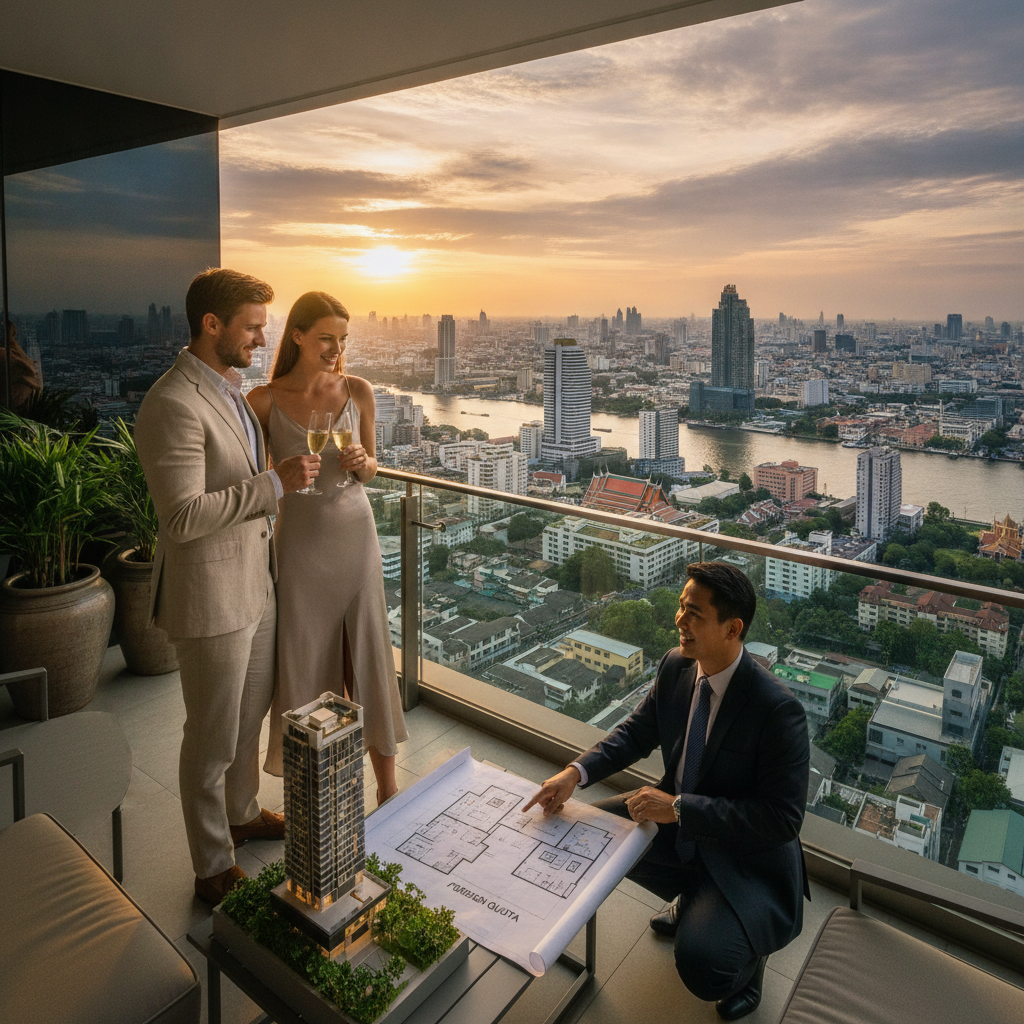
Schedule a Private Floor Plan Analysis and Quota Availability Review
The difference between buyers who secure the right Bangkok condo in 2026 and those who spend six months in indecision is access to real-time foreign quota data, verified title information, and honest yield modelling — before they make an offer, not after.
We provide private, no-obligation floor plan analysis sessions and foreign quota availability reviews for serious buyers. These are not sales presentations. They are structured data briefings covering the specific buildings, layouts, and address tiers that match your ownership intent, budget, and hold horizon.
What a private briefing covers:
- Current foreign quota utilisation across your target buildings — sourced from juristic person certificates, not developer marketing teams
- Side-by-side tax cost modelling for your specific transaction structure (new-build vs. secondary market, individual vs. company, outright purchase vs. leasehold)
- Net yield projections for shortlisted units based on actual rental transaction data from the past 12 months — not developer projections
- Land Department transfer timeline and FET documentation checklist specific to your country of origin and fund source
- Introduction to a vetted Bangkok property lawyer for independent due diligence — at no referral fee
If you are a serious buyer with a defined budget above THB 8M, a clear ownership timeline, and funds ready for offshore transfer, this briefing is the most efficient use of two hours before you commit to any unit in Bangkok's 2026 market.
Request your private floor plan analysis and quota availability review using the contact form below. Response within 24 hours, conducted in English, Mandarin, or Thai as preferred. No obligation. No sales pressure. Just the data you need to buy correctly.