Bangkok Property for Foreigners in 2026: Navigating the Shifting Sands of Leasehold Ownership

The 2026 Reality Check: What Foreign Buyers Can — and Cannot — Own in Bangkok
Foreign nationals cannot own freehold land in Thailand outright. That single sentence has derailed more relocation plans than any other legal fact in Southeast Asia — yet in 2026, the mechanisms available to foreign buyers are more structured, more regulated, and paradoxically more secure than they have ever been.
The two primary ownership pathways remain condominium freehold title (capped at 49% of total floor area per building sold to non-Thai nationals) and long-term leasehold agreements on landed or villa-style assets. A third route — company ownership through Thai-majority shareholding structures — has been aggressively scrutinized by the Department of Land since late 2024, with the nominee crackdown enforcement intensifying through 2025 and 2026.
Understanding these distinctions is not a legal formality. It is the foundation of every sound investment decision a foreign buyer will make in this market.
Insider Property Insight: Bangkok's Department of Land now cross-references shareholder nationality registers against land transfer records in real time. Any nominee structure established after January 2024 that shows a foreign beneficiary controlling more than 40% of effective economic interest is subject to automatic audit — and potentially forced divestment. Buyers relying on pre-2024 structures should obtain a current legal opinion before any resale or refinancing event.
The city's most sought-after districts — Sukhumvit, Silom, Sathorn, Riverside, and the emerging Rama 9 corridor — each carry their own micro-market dynamics for foreign buyers. Foreign quota availability in a specific condominium building on a specific soi can shift within weeks of a major developer launching a global sales campaign. Timing and building-level data matter more than neighborhood-level generalizations.
Decoding the True Value of Leasehold in Bangkok's Premium Residential Sector
What is a leasehold property in Bangkok, and is it safe for foreigners to buy?
A leasehold property in Bangkok grants a foreign buyer a registered, enforceable right to occupy and use a property for a fixed term — typically 30 years, renewable by contractual agreement for up to two additional 30-year periods. Registered at the Land Department, a properly structured Bangkok leasehold is legally binding, transferable, and financeable under Thai law.
The critical qualifier is registered. An unregistered lease agreement, regardless of how detailed its contract language, provides no protection if the landowner dies, sells, or is placed into receivership. Any premium leasehold acquisition in Bangkok must be registered on the title deed (Chanote or Nor Sor 3 Gor) at the Land Department — full stop.
The 90-Year Leasehold Framework: What Changed in 2025–2026
Thailand does not permit a single lease term exceeding 30 years under the Civil and Commercial Code. However, the 90-year structure that has become the market standard for high-end villa and landed developments achieves longevity through a cascade of three sequential 30-year leases, each registered separately at the Land Department at the commencement of each period.
What changed materially in 2025 was the Land Department's clarification that all three lease periods must be documented in a single overarching framework agreement at the time of original registration — and that the renewal obligation must be explicitly recorded against the title. Developers who previously offered verbal or side-letter renewal commitments can no longer satisfy due diligence requirements from foreign institutional buyers or their legal advisors.
- Registered Term: 30 years — the only period that carries statutory legal protection in a Thai court.
- Framework Agreement Term: Up to 90 years — enforceable in contract law, with renewal contingent on the landowner's compliance and survival of the legal entity holding the title.
- Premium Position: Leasehold properties in Bangkok's Grade A residential zones — particularly Sathorn, Wireless Road, and the Chao Phraya Riverside — often trade at 15–25% below equivalent freehold condominium values per square metre, creating a measurable entry-price advantage for buyers who understand the risk profile.
- Exit Liquidity: The secondary market for premium Bangkok leaseholds has deepened significantly since 2022. Expat-to-expat resales of sub-15-year remaining leases in buildings with strong management track records are transacting regularly — a dynamic that did not exist a decade ago.
- Land Appreciation Bypass: Leasehold buyers capture location appreciation indirectly through rental yield and lifestyle value, not through land equity accumulation. Buyers seeking capital appreciation via land value must structure through condominium freehold or face this inherent structural limitation.
The 2026 market reality is this: leasehold is not a compromise position for buyers who cannot afford freehold. In Bangkok's most land-constrained premium zones, there is no freehold land available at any price. Leasehold is the only instrument that places a foreign family inside a garden villa on a Silom side street or a riverside compound in Bang Rak — assets whose lifestyle proposition no high-floor condominium can replicate.
Condominium Freehold: The 49% Foreign Quota and How to Navigate It in 2026
How does the 49% foreign quota work for Bangkok condominiums, and can it be exceeded legally?
The 49% foreign quota means that no more than 49% of the total registered floor area in a Thai condominium project may be transferred to non-Thai nationals under freehold title. Once this threshold is reached in a specific building, foreign buyers must either wait for existing foreign-owned units to re-enter the market or acquire under a leasehold structure from the developer — if one is offered.
It cannot be legally exceeded through nominee arrangements without triggering Land Department scrutiny and potential criminal liability under the Land Code and the Foreign Business Act.
Quota Availability as a Live Due Diligence Item
In 2026, checking foreign quota availability is not a one-time search. It is a live due diligence item that must be verified at the Land Department within days of submitting an offer on any resale condominium unit in a high-demand building.
Buildings in the Sukhumvit 24–39 corridor, the Sathorn–Narathiwas intersection zone, and the Lumphini–Wireless Road precinct have seen foreign quota fill rates accelerate sharply since the Thai Elite Visa expansion in 2023 brought a new wave of European and East Asian long-stay residents into the market as buyers rather than renters.
- New Launch Quota Strategy: Thai developers of premium projects increasingly pre-allocate foreign quota units at a price premium of 8–15% over equivalent Thai-quota units. For buyers who require freehold certainty, this premium is often rational relative to the legal risk of alternative structures.
- Resale Foreign Quota Transfer: When a foreign-owned unit is resold to another foreign national, the quota transfer is automatic — the unit does not revert to the Thai quota pool. This is the mechanism that sustains the secondary market for foreign-owned Bangkok condominiums.
- Thai Quota Units for Foreign Buyers: A foreign buyer can purchase a Thai-quota unit through a legitimately operating Thai company in which they hold a minority economic interest — but only if the company has genuine business operations and Thai majority shareholders who are not nominees. Post-2024, this structure requires a significantly higher compliance burden than it did historically.
Seamless Living: Bangkok's Transit Infrastructure and Its Impact on Foreign Buyer Demand by District
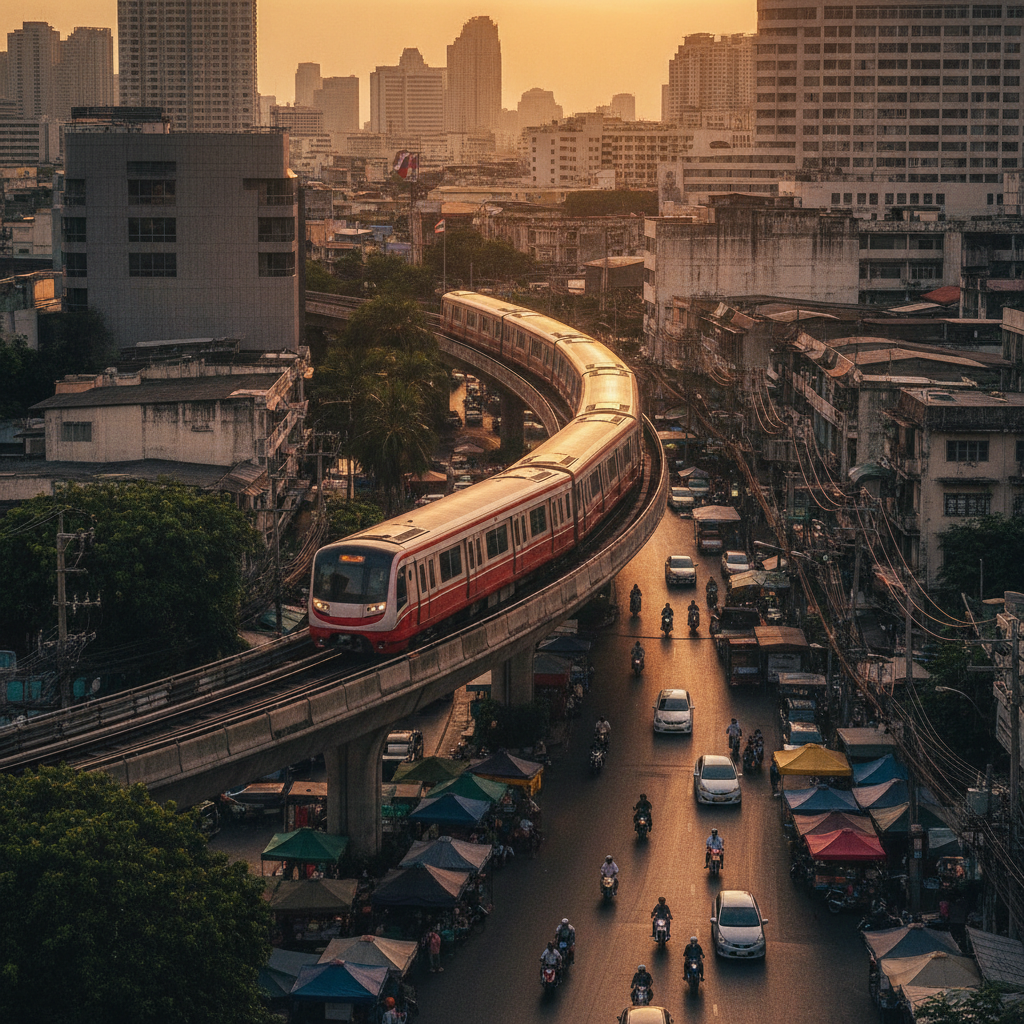
Bangkok's BTS Skytrain and MRT subway networks are not merely convenience features for expatriate residents. They are the primary determinant of rental yield sustainability and resale liquidity for foreign-owned condominium assets — a fact that Bangkok's institutional landlord community has understood for years and that private foreign buyers are only now fully internalizing.
A premium condominium within 300 metres of a Sukhumvit BTS station commands a structurally different rental yield profile than an architecturally identical building 800 metres from the same station. The 2026 data from Bangkok's leading residential agencies consistently shows a 12–18% rental premium for true walk-to-station assets — a premium that compounds into significantly higher capital values over a 10-year hold period.
- Sukhumvit BTS Corridor (Nana to On Nut): The highest-density concentration of foreign-quota condominium supply and the deepest expat rental demand pool in the city. Yields for well-managed one- and two-bedroom units in buildings with strong foreign quota availability range from 4.5–6.2% gross annually in 2026.
- Silom–Sathorn MRT/BTS Interchange Zone: Bangkok's financial district draws a distinct tenant profile — senior finance, legal, and corporate executives with longer average tenancy periods and higher absolute rent tolerances. Two- and three-bedroom units near Sala Daeng and Chong Nonsi stations are the preferred product type.
- Rama 9 MRT Corridor (Emerging Premium Zone): The fastest-appreciating district for foreign buyers willing to accept a 15-minute longer commute in exchange for larger floor plates at lower per-square-metre entry prices. The extension of the Orange Line MRT through this corridor is the single largest near-term transit catalyst for Bangkok property values outside the CBD.
- Riverside — Chao Phraya (BRT and Future MRT Extension): The most lifestyle-rich district for leasehold villa and boutique condominium buyers. Transit connectivity is the weakest link, but the development of the riverside MRT extension — with confirmed stations near Charoen Nakhon and Bang Rak — is expected to close the transit gap materially by 2028.
- Ari–Phahon Yothin BTS Zone: The emerging preference district for European and Australian long-stay residents who prioritize walkable neighborhood character over CBD proximity. Foreign quota fill rates in this corridor remain below 30% in most buildings, giving 2026 buyers genuine choice at the point of entry.
The practical implication for foreign buyers is straightforward: budget a transit-proximity premium into your acquisition cost as a non-negotiable line item, not an optional upgrade. The secondary market will price it in on exit regardless of whether you paid for it on entry.
Rental Yields, Floor Plan Economics, and the Foreign Buyer's Return Profile in 2026
Bangkok Leasehold vs. Freehold Condominium: Which Delivers Better Returns for Foreign Investors in 2026?
The answer depends entirely on the buyer's time horizon and primary motivation. For a buyer with a 5–10 year hold period focused on rental income and lifestyle value, a well-located leasehold villa or townhouse in Sathorn or Riverside will typically outperform a condominium on net yield — because the acquisition cost is materially lower and the rental income from expatriate corporate tenants seeking garden space and privacy is materially higher.
For a buyer with a 10+ year horizon who wants freehold capital appreciation exposure and maximum resale liquidity, a foreign-quota condominium unit in a transit-proximate building remains the structurally cleaner investment.
Floor Plan Economics: What Foreign Buyers Are Actually Paying Per Square Metre
Bangkok's ultra-luxury condominium segment — defined as new launches priced above THB 200,000 per square metre — is predominantly purchased by foreign buyers and high-net-worth Thai nationals treating the asset as a primary or secondary residence rather than a pure yield play.
- Studio and One-Bedroom Units (28–55 sqm): The highest-yield product type on a gross annual basis (5.5–7% in prime locations), but the most management-intensive and most exposed to short-term rental platform volatility following Thailand's continued regulatory tightening of sub-30-day rentals.
- Two-Bedroom Units (65–100 sqm): The sweet spot for foreign investors in 2026. Corporate relocation packages from Bangkok's MNC community drive consistent demand for this size category, with average tenancy periods of 12–24 months providing yield stability. Gross yields of 4.5–5.8% are achievable in Grade A buildings.
- Three-Bedroom and Penthouse Units (120 sqm+): Thin rental market, long void periods between tenancies, but the strongest capital value resilience in downturns. Foreign buyers of this product type are typically end-users or family-relocating executives, not yield-driven investors.
- Leasehold Villa and Landed Product (200–600 sqm plots): Gross rental yields of 4–5.5% from premium expatriate corporate tenants, with significantly lower per-square-metre acquisition costs than equivalent-quality condominium product. The risk premium — reflecting the leasehold structure's dependency on landowner covenant — is the buyer's primary underwriting consideration.
The Currency Advantage That 2026 Foreign Buyers Should Not Ignore
The Thai Baht has depreciated meaningfully against the US Dollar, Euro, British Pound, and Australian Dollar over the 2023–2025 period. For foreign buyers purchasing Bangkok property with hard-currency savings, this depreciation translates directly into lower effective acquisition costs in home-currency terms — a structural tailwind that market observers expect to partially reverse as Thailand's current account position normalizes through 2026–2027.
Buyers who delay acquisition waiting for further Baht weakness may find themselves acquiring into a recovering currency at higher Baht-denominated asset prices — paying more in both dimensions simultaneously. The window of maximum hard-currency purchasing power advantage in Bangkok real estate is most likely in the 2025–2026 period, not beyond it.
Legal Structures, Due Diligence Checklist, and the Non-Negotiables for Foreign Buyers in 2026
The Five Non-Negotiable Due Diligence Steps for Any Foreign Buyer in Bangkok
Bangkok's property market is not a caveat emptor market in the Western sense — but it rewards buyers who approach due diligence with the same rigor they would apply to a commercial real estate acquisition. The five steps below are the minimum threshold for any foreign buyer committing capital above THB 5 million.
- 1. Independent Title Search at the Land Department: Verify the title deed type (Chanote is the only fully bankable, fully transferable freehold title), confirm the absence of encumbrances, mortgages, or third-party rights registered against the title. Do not rely on the developer's or agent's title representation alone.
- 2. Foreign Quota Verification (For Condominium Purchases): Obtain a written statement from the condominium juristic person confirming the current foreign ownership percentage at the time of offer — dated within 5 business days of contract signing. This is a live figure that changes with every transfer.
- 3. Developer Entity Due Diligence (For Off-Plan or New Launch): Search the Department of Business Development database for the developer's company registration, registered capital, director structure, and any insolvency proceedings or regulatory actions filed against the entity. Bangkok's 2024–2026 period has seen several mid-tier developers face project delivery delays linked to overleveraged balance sheets.
- 4. Leasehold Framework Agreement Legal Review: For any leasehold acquisition, engage a Thai-licensed lawyer (not the developer's in-house counsel) to review the framework agreement for enforceability of renewal obligations, assignment rights in the event of the buyer's death or desire to sell, and the mechanism by which the lease is registered on the Chanote at the Land Department.
- 5. Funds Remittance Compliance — The Foreign Exchange Transaction Form (FETF): This is the step most frequently misunderstood by first-time foreign buyers in Bangkok. Foreign funds used to purchase a Thai condominium must be remitted from overseas in a foreign currency and converted in Thailand — and the receiving Thai bank must issue a Foreign Exchange Transaction Form (FETF) for each remittance. The FETF is the legal instrument that permits the Land Department to transfer the foreign-quota unit into the foreign buyer's name. Without it, the transfer cannot be registered, regardless of how much money has changed hands.
Insider Legal Insight: Many foreign buyers wire funds into a Thai bank account they already hold — money that was previously converted and has been sitting in a Thai Baht account for months. This invalidates the FETF requirement. The funds must be wired from a foreign account in a foreign currency, converted at the time of receipt in Thailand, and the FETF issued against that specific conversion transaction. A single administrative error here can delay or block the entire Land Department transfer.
Schedule a Private Consultation on Bangkok Leasehold and Foreign Quota Opportunities
The gap between publicly available Bangkok property information and the building-level, unit-specific intelligence that actually drives sound acquisition decisions has never been wider than it is in 2026. Foreign quota availability, leasehold framework robustness, developer covenant strength, and transit-proximity yield premiums are not generalizable facts — they are asset-specific variables that require current, verified data.
If you are a foreign national evaluating Bangkok residential property as a primary residence, long-stay base, or yield-generating investment, the most valuable next step is a structured, no-obligation conversation with an advisor who can give you building-specific foreign quota figures, current floor plan availability across leasehold and freehold product types, and an honest assessment of where your capital is most defensibly positioned in the 2026 Bangkok market.
- ✔ Foreign quota availability verified at the Land Department level — not estimated from a brochure.
- ✔ Side-by-side leasehold versus freehold yield analysis for your specific budget range and target district.
- ✔ FETF remittance structuring guidance coordinated with your receiving Thai bank before funds move.
- ✔ Private viewing arrangements for shortlisted units, including buildings not publicly marketed through standard agency channels.
- ✔ Floor plan analysis across available unit types — identifying which layouts and orientations command the strongest rental premiums from Bangkok's corporate expatriate tenant pool.
Arrange your private consultation or floor plan analysis request today. Provide your target district, budget range, and preferred ownership structure (leasehold or freehold condominium), and receive a tailored, current-data briefing within 48 hours — with no sales pressure and no obligation to proceed.
The Bangkok property decisions that foreign buyers most regret in 2026 are not the ones they made with incomplete information. They are the ones they delayed until the foreign quota was gone, the Baht had recovered, and the specific building they wanted had closed its launch allocation. Act on verified intelligence, not on hesitation.